
S1-S3 Music: listening and remix pack (describe and rework a musical idea)
- StageS1-S3
- SubjectMusic
- Learning strandhuman-AI communication and collaboration
- Official documentsAI Literacy Learning Framework for Primary and Secondary Schools · AI Literacy Learning Framework for Primary and Secondary Schools (Examples of Application Scenarios)
- Session time1 lesson (60 min)
Pupils describe a short musical idea the teacher performs, hand their description to the school's AI tool, then compare and choose. No audio file needed.
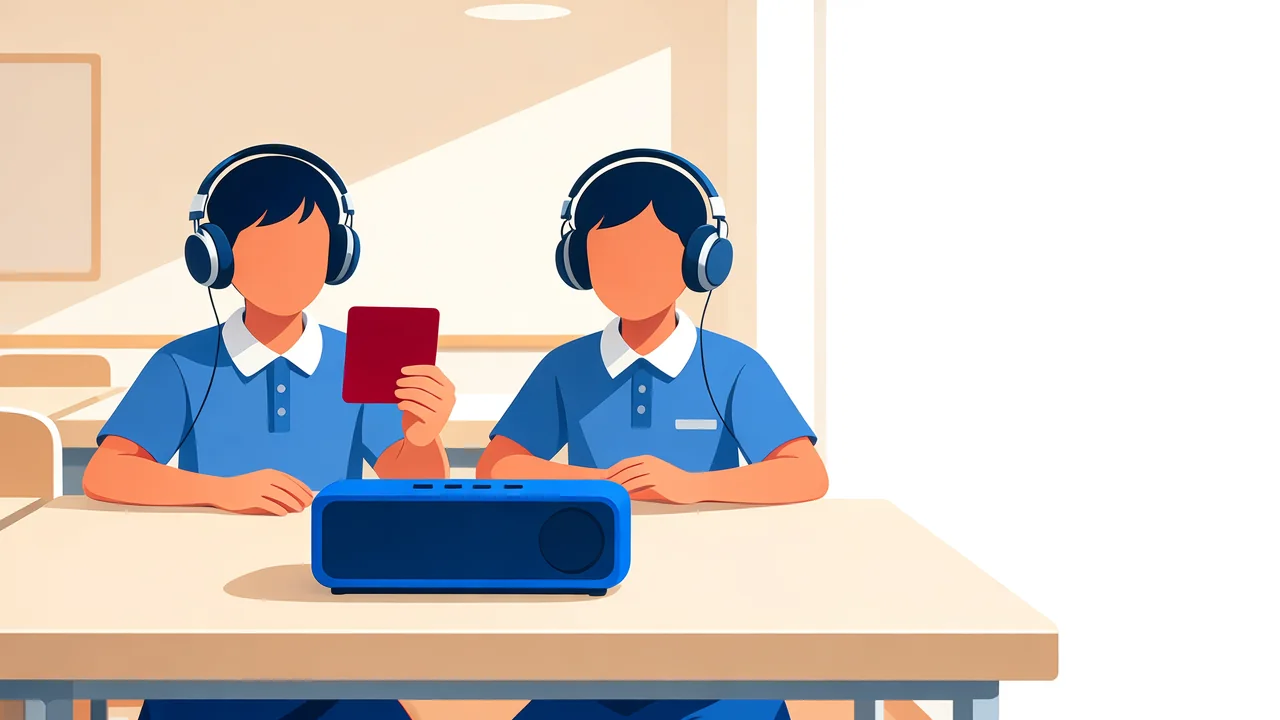
- EquipmentA way to play one short audio excerpt (optional, see the lesson steps) and printed worksheets
- Version1.9
- Last updated2026-10-17
| Key learning area | Learning elements | Points to note when using AI |
|---|---|---|
| Arts Education (Music) | listening, creating, musical elements, rhythm, appreciation | Over-reliance and the outsourcing of thinking: the AI reworks only the description the pupil has written, and the pupil judges which variation to keep; mind copyright, and use no protected recording or living composer’s work. |
What this solves
In many secondary music lessons, listening practice boils down to “tell me the mood of this piece”, and the class produces a pile of adjectives — happy, tense, sad — without any musical vocabulary. The teacher is left unsure what, if anything, the pupils actually heard.
This pack turns listening into a describable object: pupils record a short musical idea the teacher performs live against a fixed vocabulary of musical elements (pulse/tempo, metre, rhythm pattern, pitch contour, dynamics, timbre/instrumentation, texture, structure), then turn their notes into a precise 4–6 sentence description, and hand that written description to the school’s AI tool to rework. The AI works from the pupils’ description — not from any recording, and not from a living composer’s work — so the description itself becomes the assessable work, not a vague adjective.
The whole resource needs no audio file at all, and works with no playback: the teacher plays, sings, claps or writes out a short musical idea, or simply writes a rhythm pattern on the board. Pupils who cannot hear pitch accurately, or who are not confident singing, take part through rhythm, dynamics and structure alone and can still complete all four steps.
The pack can sit in the digital education part of a School Development Plan and run in a music lesson, with the pupil’s written description as assessable evidence of learning: pupils set out the musical elements in a full prompt, the AI works only from their own words, and a copyright and intellectual property discussion reminds them not to use protected recordings or a living composer’s work.
Learning objectives
By the end of the lesson, pupils can:
- Record a musical idea using a fixed vocabulary of musical elements (at least four of: pulse/tempo, metre, rhythm pattern, pitch contour, dynamics, timbre/instrumentation, texture, structure).
- Turn their notes into a precise 4–6 sentence description, precise enough that someone who never heard it could reconstruct its shape.
- Hand that description to the school’s approved AI tool, ask for at least one change (change the metre, invert the contour, thicken the texture), and say that the AI works only from their own words.
- Compare the variation with their description and the original idea, and justify in writing which one they would keep and why, naming at least two musical elements.
Written for the junior- and senior-secondary learning stages, it covers the human-AI communication and reflection on the application of AI strands of AI literacy, with human-AI collaboration and critical thinking at its centre.
Teaching steps
One 60-minute lesson, in four segments.
- Introduction, demonstration and vocabulary (10 min) — Set the goal: we are turning “hearing” into “describing”. Agree two rules: no judging whether something sounds “good”; and later the AI will work only from our words, never from any recording. The teacher performs a short 4–8 bar musical idea live (play, sing, clap or write it; with no instrument, write a rhythm pattern on the board). The class listens through the vocabulary once; the teacher models filling one row of the listening log (see the download).
- Listening log and writing the description (20 min) — The teacher performs the idea twice more; pupils fill in “what I heard” and “musical term” for each element. Pupils who cannot hear pitch accurately may complete rhythm, dynamics and structure only. Pupils turn their notes into a 4–6 sentence description, using the weak-vs-strong pair (below).
- Swap, wrap up and recap the boundary (15 min) — Pairs swap descriptions and guess which element the other was describing; the teacher sums up the three conditions of a precise description: use musical terms, name the elements, be precise enough to rebuild. Recap the idea and description from the start of the lesson; hand out the remix brief template and make the boundary clear: do not upload any commercial recording; the AI works only from the pupils’ written description.
- Hand it to the AI, compare and share (15 min) — Pupils hand their description plus one change request to the school’s approved AI tool (or the teacher models one run), and receive a variation as a description or notation. Pupils compare the variation against their description and the original idea, and write in the comparison frame which one they would keep and why, naming at least two musical elements. Two or three pairs share their judgement; the teacher makes the point: the more precise the description, the closer the variation is to what was wanted; the AI only works from words, and the judgement stays with the pupils.
Answer key and marking notes
First, a note: every musical idea and description below is fictional, invented by the class itself; teachers can swap in their own class’s idea. The vocabulary, examples and marking guide can be printed as they are.
Element vocabulary (plain-language definitions)
| Element | Plain meaning | Everyday way to say it |
|---|---|---|
| Pulse / tempo | How fast the music moves | “fast / medium / slow”; “like walking or running” |
| Metre | How many beats in a bar, and how they group | “in three or in four”; “where the strong beat falls” |
| Rhythm pattern | How long and short notes are arranged | “long-long-short”, “one long two short”; “ta ta ti-ti” works too |
| Pitch contour | Whether the melody rises or falls | “from low to high”, “up to the top then back down” |
| Dynamics | Loud or soft, and whether it changes | “suddenly loud”, “gradually softer” |
| Timbre / instrumentation | What sound, what instrument or voice | “piano sound”, “clapping”, “low and dark or high and bright” |
| Texture | How many layers sound together, whether there is accompaniment | “one melody alone”, “melody with accompaniment”, “several together” |
| Structure | How many phrases or sections, whether anything repeats | “two phrases, the second like the first”, “an A and a B section” |
Listening log (worked example)
| Element | What I heard | Musical term |
|---|---|---|
| Pulse / tempo | Medium-fast | Medium-fast (about 120 beats per minute) |
| Metre | Grouped in four | 4/4 |
| Rhythm pattern | Mostly “long-short-short” repeated | Crotchet + two quavers |
| Pitch contour | Rises then falls | Arch shape (up then down) |
| Dynamics | Grows from soft | Crescendo (getting louder) |
| Timbre / instrumentation | Voice or clapping only | Unaccompanied, one sound |
| Texture | One melody, no accompaniment | Monophonic |
| Structure | Two phrases, four bars each | A A’ (the second like the first) |
Weak vs strong description (fictional example)
Weak: “This music is really happy and fast, like running.”
Strong: “4/4, medium-fast (about 120 beats per minute). The melody climbs step by step from low to high and falls back; the rhythm is mostly a repeated crotchet-plus-two-quavers figure; the dynamics grow from soft. The texture is a single unaccompanied melody, in two phrases of four bars, the second close to the first.”
What is the difference? The strong description uses the fixed vocabulary and names each element, so someone who never heard it could rebuild the shape; the weak one is only a feeling adjective, which gives the AI nothing to work on.
Remix brief template (with the AI-use boundary)
| Field | Pupil fills in |
|---|---|
| My description (4–6 sentences) | |
| One change I want | For example: change it to three beats; invert the pitch contour; thicken the texture |
| Boundary | The AI works only from my words; do not upload any recording or anyone else’s work |
The boundary rule (teachers must state it): the idea the teacher performs is the class’s own original idea; the AI works from the pupils’ written description, never from any recording, and never from a living composer’s work. Pupils must not upload a commercial recording to any AI tool.
Comparison and justification frame
| What to compare | My original idea | My description | The AI’s variation | Which one would I keep? Why (name at least two musical elements) |
|---|---|---|---|---|
| Tempo | ||||
| Metre | ||||
| Pitch contour | ||||
| Texture |
Marking guide
| Level | What it looks like |
|---|---|
| Strong | Records at least four musical elements accurately; writes a 4–6 sentence description precise enough to rebuild; asks for a specific change that fits the description; justifies “which to keep and why” naming at least two musical elements. |
| Developing | Records two or three elements but in vague words (for example only “fast” or “loud”); the description stays at adjectives and lacks rebuildable detail; comparison is only “nice / not nice”. |
| Needs help | Cannot turn what was heard into musical terms; the description is only feeling words; cannot give any reason for a comparison. |
What not to grade
- Do not grade whether the AI’s output sounds “good”: this resource does not judge how well AI makes music, and does not rank any AI tool — use the school’s approved AI tool only.
- Do not grade whether a pupil used AI, or how well they know a tool: what is scored is the description and the judgement, not the tool.
- Do not grade singing or playing, and do not grade pitch accuracy: pupils who cannot hear pitch accurately, or are not confident singing, have completed the task by working through rhythm, dynamics and structure alone.
- Do not grade “they uploaded a recording”: the rule is that no commercial recording may be uploaded; pupils submit their own written description only.
Files
Music listening and remix pack (editable Word document) — includes the element vocabulary, the listening log, the weak-vs-strong description pair, the remix brief template, the comparison and justification frame, and (after a page break) the marking guide and answer notes.
All musical ideas and examples are fictional, invented by the class, and do not involve any real piece, composer or recording.
Official documents
Every resource in this library is written to the AI Literacy Learning Framework for Primary and Secondary Schools and falls within the policy scope of the Blueprint for Digital Education Development in Primary and Secondary Schools.
This resource maps to:
- Supplement I: AI Literacy Learning Framework for Primary and Secondary Schools (p.1-8): sets out the AI literacy competencies pupils should develop — using AI appropriately and understanding its limits, rather than treating it as a box that only produces answers. This pack practises exactly that: pupils describe in their own words, then judge the AI’s output.
- AI Literacy Learning Framework for Primary and Secondary Schools (Examples of Application Scenarios) (p.15): a Music scenario for junior and senior secondary in which pupils listen, describe each track in musical terms, and rework the passage into their own version; this resource applies the describe–rework–judge loop to Music.
Learning strand: human-AI communication and collaboration
Official documents page: https://www.edb.gov.hk/en/edu-system/primary-secondary/applicable-to-primary-secondary/it-in-edu/debp.html
This page is an independent Beets teaching resource, not an official EDB document.
Feedback
If you have any comments or questions about this resource, or an idea for the next one, tell us on the feedback page.
Related resources
Reuse
Download and adapt these resources freely for teaching; please keep the attribution.