
S1-S6 Class teachers and parents: AI, sleep and self-image — five scenario cards, three questions and a one-page unnamed record (two class-teacher lessons)
- StageS1-S6
- SubjectClass teachers and parents
- Learning strandreflection on the application of AI, and human-machine communication and collaboration
- Official documentsBlueprint for Digital Education Development in Primary and Secondary Schools · AI Literacy Learning Framework for Primary and Secondary Schools · Guide to Using AI in Teaching in Primary and Secondary Schools · EDBCM No. 156/2026
- Preparation timeabout 45 minutes to prepare the first time (choose and print the cards); two class-teacher lessons of 60 minutes each
The last one before sleep, not wanting to be photographed after a comparison, a confidence that comes only from a tool, being told what kind of person you are, and one question asked ten times — five scenario cards, three questions in a fixed order, and a one-page four-column unnamed record across two 60-minute lessons.
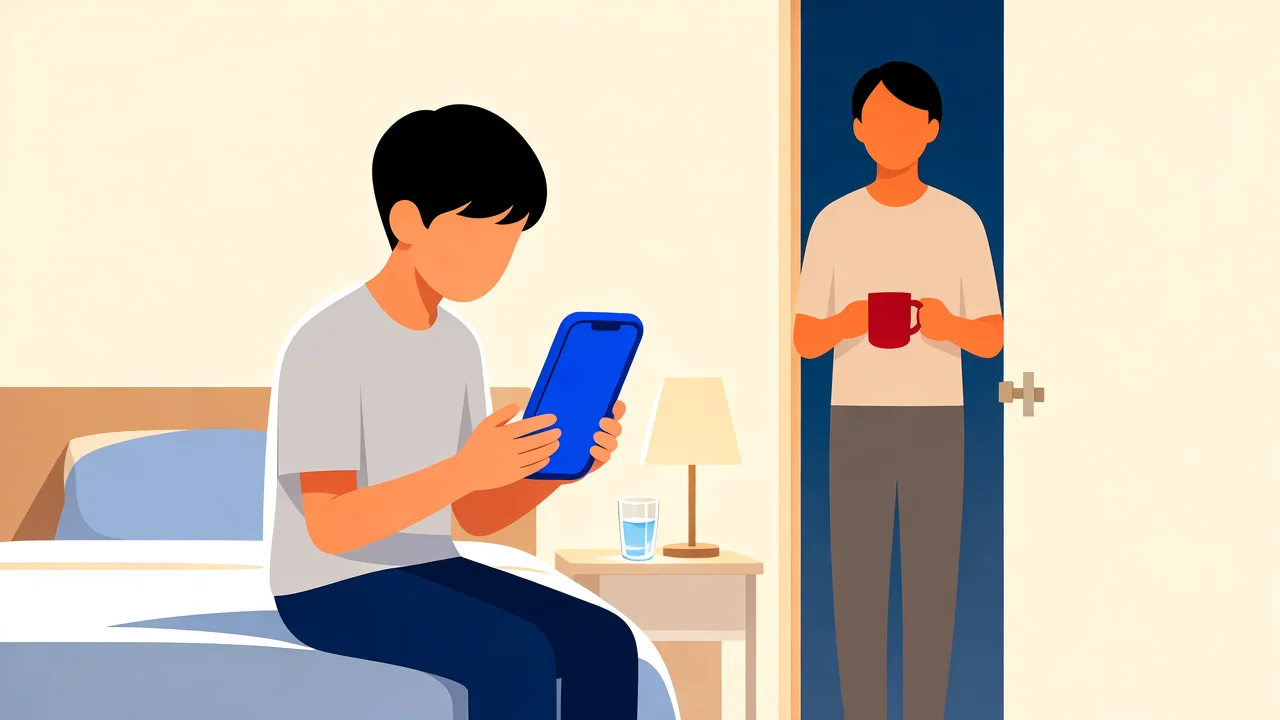
- Equipmentfive scenario cards (one set per group, printed or made by the teacher); the three questions on one page; the four-column unnamed record (one per teacher); a whiteboard or projector
- Version1.0
- Last updated2026-11-11
A pupil can tell you how much they used it; very few can tell you what they were after. Five cards separate five situations, and three questions ask the same thing three times — the order is the part of the lesson that has to hold.
What this solves
A class teacher usually does not miss this. What is missing is a sentence to open with. The pupil says “nothing”, the teacher says “stop being on your phone all the time”, and there is no third sentence. The pupil is not much better equipped: what they remember is “I was still looking at one in the morning”, not “I wanted someone to answer me”.
So this page separates five common situations onto five cards, then adds three questions, a one-page four-column record, and two lessons of 60 minutes each. It is not about how much anyone used, and it does not decide whether any pupil has a problem. It is about one tool and five different things wanted, and about a question a teacher can actually ask.
The five cards are separate because they look identical from outside — all five are “using it a lot” — and underneath they are not the same want:
- Card one is not being able to stop: it is not that the next item looks interesting, it is that there is no moment at which stopping is decided.
- Card two is comparison: a generated image and other people’s images sit side by side, and the pupil no longer wants to be photographed.
- Card three is substitution: what gets no response in class gets an instant response from the tool, so it moves there.
- Card four is being classified: the tool says “you are this kind of person”, and the pupil starts acting on it.
- Card five is certainty: the same question asked ten times, each time wanting a firmer answer.
Merge the five into one card called “too much phone” and there is nothing left to teach: the pupil hears an evaluation and goes quiet. Separated, they can answer “what were you after?” — which is the first of the three questions.
Three statements to read first:
- The names “five scenario cards”, “three questions” and “the unnamed record” are this resource’s suggestion, not something the Education Bureau has named. They rest on two things the documents do ask for — attention to student wellbeing and avoiding over-reliance — and the documents set no number of cards, number of questions, order of questions or lesson structure.
- The page quotes one line only: “refer to the relevant advice of bodies such as the Department of Health and the Education Bureau”. The specific figures — hours of sleep, minutes of use — are for the school to take from those bodies’ own publications. This page and its attachments carry no hours, no minutes and no percentages: a figure copied wrongly and then repeated at a parent meeting is the school’s error, not ours.
- The line on introducing technology progressively is divided by learning stage (junior primary and upper primary). This page covers S1–S6, so it takes only the avoid over-reliance principle from it, and does not present that line as a requirement for secondary schools or quote the arrangements for the primary stages.
Four things this page does not do:
- It claims no cause. Some pupils use a great deal and sleep well; some pupils use a great deal on nights they cannot sleep. Both happening together does not mean one caused the other. The page never states that using AI causes insufficient sleep, and never states that not using it prevents anything.
- It uses no diagnostic names. No diagnostic label appears anywhere: only observable situations and words a pupil can actually say. Where there may be an emotional or mental-health need, refer through the school’s existing arrangements; this page replaces no professional assessment.
- It sets no scale. No score, no level, no ranking, and it must not be rewritten as a questionnaire or a screening tool.
- It names no tool. Everything is written as “the tool”; no platform, brand or supplier is named, and no sequence of steps for using one is taught.
Learning objectives
By the end of the two lessons, pupils can:
- Say what each of the five cards is, and that the cards share one tool while differing in what the pupil wanted at the time.
- Answer the three questions in their fixed order: what did you want to get → what did it give you, and what did it take away at the same time → who could you tell about this.
- Explain why the second question says “take away” rather than “harm”: it is about two sides of one thing, not a judgement of a person.
- Write at least one person on the list for the third question — family, a classmate, a teacher, the social worker, the counselling team — and say why the list cannot be empty.
- Explain that the record carries no names, is not a mark, and is not a conduct or counselling record.
The lesson is written around the three learning strands of AI literacy and addresses reflection on the application of AI and human-machine communication and collaboration; the three strands are the basic operation of AI, human-machine communication and collaboration, and reflection on the application of AI. Three values are practised at once: critical thinking is refusing to treat “uses it a lot” and “has a problem” as one finding; responsibility is being able to say what you wanted and what it took away; using technology at the right time is knowing when to put it down and when to go to someone.
Teaching steps
The attachments are two Word documents: the five scenario cards and the three questions (the cards cut apart, one set per group), and the one-page four-column unnamed record with the two-lesson run sheet (the record copies on its own). Each lesson is 60 minutes — not squeezed into 45: the cards need reading time, the questions need asking time, and the close needs room.
The five scenario cards (five, fixed)
All five are fictional: no real school, name or class, and no links or screenshots that could be opened. Each card is one short paragraph, and after reading it the class is asked one thing: “What do you think he wanted at the time?” Nobody is asked to judge, and nobody is asked to admit to being the pupil on the card.
| Card | The situation (as printed) | What the card is looking at |
|---|---|---|
| Card 1 · The last one before sleep | Every night he says “one more and then I’ll sleep”, and one follows another from eleven at night until one in the morning; asked the next day what he watched, he cannot say. | What will not stop is not the content, it is the decision about when to stop. |
| Card 2 · The comparison | A generated image and other people’s images appear side by side in the same frame; he stops wanting to be photographed and feels he does not “look right”. | After the comparison he is no longer looking at a photograph, he is measuring against a ruler. |
| Card 3 · Praise that comes only from the tool | Something said in class got no response; the tool answered at once, so he stopped raising it in class and kept it there. | It is not that he does not want to speak; he tried in class and nothing came back. |
| Card 4 · Being classified | The tool tells him “you are this kind of person”; he starts acting on that, for example giving up on a subject. | One act of classification becomes a reason not to try again. |
| Card 5 · One question, asked to the end | He asks the same question ten times, each time wanting a firmer answer; the more uneasy he becomes, the more he asks. | What he wants is not the answer, it is the moment of certainty that would let him stop. |
Three rules for using the cards:
- One card at a time. Hand out all five and the class starts ranking them by severity, which is the one thing this lesson does not do.
- Card two is the only one the teacher demonstrates first. Not every pupil has experienced “side by side”, so the teacher reads the situation aloud and then asks: “If you were him, would you want your photo taken?”
- Cards four and five do not go in the same lesson. Both are about a pupil starting to believe a statement; together they drown each other out. In the second lesson, card three sits between them in the rotation.
The three questions (three, fixed order)
The three questions sit on one page, and the order is not changed, merged or added to. The order is the content of the lesson: the want comes first, and who you could tell comes last.
| Question | How it is asked (read it as written) | Why this wording | What it must not become |
|---|---|---|---|
| Question 1 | What did you want to get at the time? | The want comes first, not the time spent. Once a pupil can say “I wanted someone to answer me” or “I wanted something to fill the gap”, the lesson has a starting point. | Not “how long were you on it?” — ask about time and the only answer left is time. |
| Question 2 | What did it give you, and what did it take away at the same time? | One question, two sides. Pupils can usually say what it gave; the side it took away needs someone alongside. | “Take away” must not be replaced by “harm” — harm is an evaluation, taking away is one side of one thing. |
| Question 3 | Who could you tell about this? | There must be someone on the list. Not “you should talk to someone” but “who could you tell” — and an empty answer is what the lesson has to follow up. | Not “why didn’t you tell anyone?” — that turns the question into a reproach, and the list empties. |
How the three questions are used:
- Every card gets the same three questions. No card gets its own question, and no fourth question is added (“and how do you feel about it?”) — add one and the order is no longer fixed.
- Question two is written as “take away”. On the board the teacher writes “take away”, never “harm”, “impact” or “consequences”.
- The list for question three is written down. “Anyone, really” does not count; there has to be a specific person or post, written down or named aloud.
The one-page four-column unnamed record (four columns, fixed)
One page, four columns, filled in by the teacher and carrying no names. It is not the pupils’ work and it is not how this lesson is marked.
| Column | What goes in | What does not |
|---|---|---|
| 1 · Category of situation | One of the five cards, or “other: one sentence” | No pupil’s words, no speculation |
| 2 · How often it came up | Three coarse bands: once / a few times / many times | No minutes, no hours, no dates or times |
| 3 · What the class arrangement has been | For example: the three questions were taught to the whole class; card three was read in a group; one individual reminder was given | No conclusions such as “counselled” or “dealt with” |
| 4 · Who needs to follow up | A post, for example: counselling team, school social worker, class teacher, parent | No name, student number or seat |
Four rules, printed at the foot of the record:
- No names. No pupil’s name, student number or seat, and no description (“third row, second from the left”) that would identify anyone.
- No marks. No score, level or ranking; this page is not a conduct record and not a counselling record.
- Individual cases are recorded elsewhere. Anything needing individual follow-up is recorded under the school’s own arrangements and is not written on this page.
- Immediate danger is referred immediately. If a pupil discloses thoughts of self-harm or immediate danger, refer at once under the school’s crisis procedure and do not deal with it inside the lesson; the lesson stops there, and nothing about it goes on this page.
Lesson one (60 minutes)
| Time | What is done | What pupils do |
|---|---|---|
| 8 min | Framing: this lesson is about five situations, not about anyone’s hours; nobody will be named and nobody will be asked “do you do this”. | Listen; may choose not to speak |
| 12 min | Card one: read the situation, then ask only “what do you think he wanted?” | Offer one sentence; no evaluation of the pupil on the card |
| 12 min | Card two: the teacher reads it aloud first, then asks “if you were him, would you want your photo taken?” | One minute in pairs, then two sentences to the class |
| 13 min | Demonstrating the three questions: the teacher works through them on card one, then writes the order on the board and notes that the second question is “take away”, not “harm”. | Copy the order of the three questions from the board |
| 10 min | Whole-class comparison: the answers for cards one and two go on the board side by side, compared only on “what was wanted” and “what was taken away”. | Say which column matches and which does not |
| 5 min | Close: the class reads the three closing sentences together. | Read together |
Lesson two (60 minutes)
| Time | What is done | What pupils do |
|---|---|---|
| 5 min | Recall: re-read the order of the three questions — read only, no explanation. | Read aloud once |
| 25 min | Cards three to five in rotation: three groups, one card each, the same three questions; each group writes one sentence on the back of its card for “what was wanted” and one for “what was taken away”. | Rotate in groups; answer the three questions only |
| 12 min | The one-page record: the teacher fills the four columns once as a demonstration, saying that it carries no names, no marks, and only the category and the arrangement. | Do not fill it in; watch the demonstration |
| 13 min | Referral and limits: three things are stated — this page will not carry your name; anything individual is followed up by someone else; if there is immediate danger the teacher hands it on at once and does not keep it in the room. The three posts a pupil can go to are written up. | Write their own list for question three (they may keep it) |
| 5 min | Close: the class reads the three closing sentences together. | Read together |
Five cards means five, three questions means three, and the record has four columns. No lesson adds a card, a question or a column. If time runs short, take less depth — never fewer cards, and never a different order.
The teacher’s four checks
- The teacher chooses and reads the cards. All five are fictional and must not be replaced with something that happened in the class; no real screenshot, conversation or photograph is used, and no card carries a name.
- Pupils are not asked about themselves. No show of hands, no “have you ever”, and nobody is asked to admit anything. If a pupil volunteers something, the teacher responds with one sentence and does not ask for detail.
- The order of the three questions does not change. The teacher writes the order on the board during the demonstration and, while moving between groups, corrects the order only — never adds a fourth question.
- The limits and the referral are stated plainly. There must be someone on the list for question three; if a pupil discloses thoughts of self-harm or immediate danger, refer at once under the school’s crisis procedure, do not deal with it in the lesson, and do not write it on the record.
Three closing sentences (the class reads them together)
- “I can say what I wanted at the time.”
- “I can say what it gave me, and what it took away.”
- “There is someone I could tell about this.”
The third is the only requirement of the lesson: someone has to be on the list. When the teacher hears it, they repeat it once and add nothing.
Where this meets other resources in the library
Interfaces only; nothing here redoes their work:
- Talking to a chatbot: recognising over-reliance works with five observable signals and a three-step response for substitution and emotional reliance. This page borrows the single idea of substitution (card three) and does not rewrite the five signals, the three-step response or the referral flow.
- The family AI agreement covers arrangements at home (when, where, and where the device goes afterwards). This page covers one lesson in school and does not write a family agreement.
- The supervision guide for junior pupils covers supervision in P1–P3. This page is S1–S6 and the boundary differs: one is about supervising, the other about what a pupil can say themselves.
Answer key and marking notes
The lesson is not marked and has no levels or ranking. What follows are the acceptable answers for the teacher’s use during the lesson and the demonstration.
What was wanted, and what was taken away, for each card (more than one answer is acceptable):
| Card | What was wanted (acceptable) | What was taken away (acceptable) |
|---|---|---|
| 1 | Company while falling asleep; not having to think; winding down | Sleep; being rested the next day; the judgement about when to stop |
| 2 | To know how they “should” look; to be thought good-looking | Acceptance of their own face; willingness to be photographed; ease in looking at people |
| 3 | An immediate reply; to be remembered | The chance to speak in class; the chance for classmates to know |
| 4 | Someone to place them; to know what kind of person they are | The chance to try (a subject, for instance); the chance for others to see them |
| 5 | A firm answer; peace of mind | The time to stop; trust in the answer, which weakens with every repetition |
Model answers for the three questions (the teacher uses card one):
- Question 1: “I wanted someone there with me — I didn’t want to be alone with my own thinking.”
- Question 2: “It gave me an hour without thinking. It took away being rested the next day, and knowing when to stop.”
- Question 3: “I could tell my class teacher; I could tell someone at home.” — the list needs a specific person or post.
Common wrong answers and how to respond:
- Question one answered with time. “I was on it for two hours.” Response: “Two hours is the time. What I want to know is what you were after.”
- Question two answered with “harm”. “The harm is my grades.” Response: “We’re not doing harm, we’re doing what it took away — both sides of the same thing.”
- Question three answered “nobody”. That is an important answer, not a wrong one. Response: “Then let’s write one down: in school, who would you most want to know?” If there is nobody, that is what the lesson follows up — recorded as a post in column four, with no pupil’s name.
- Card four answered “well, he is that kind of person”. Response: “The line on the card is a classification, not a fact. What we are looking at is that he stopped trying.”
- Asking the teacher how much counts as too much. Response: “This lesson doesn’t do hours; that is for the school to settle from the bodies’ advice.” (This page carries no figures.)
Checklist (the teacher runs through it once before printing and teaching):
- □ All five cards are present, and only five: the last one before sleep, the comparison, praise only from the tool, being classified, one question asked to the end.
- □ All three questions are present, in the order: what did you want to get → what did it give you and what did it take away → who could you tell.
- □ Question two says “take away” throughout, and nothing anywhere turns it into “harm”.
- □ The record has four columns only: category, how often, what the class arrangement has been, who needs to follow up.
- □ The record has no field for a name, student number or seat, and prints “no names, no marks, not a conduct or counselling record”.
- □ The record prints “individual cases are recorded under the school’s arrangements and are not written on this page”.
- □ The page states that a disclosure of self-harm or immediate danger is referred at once under the school’s crisis procedure and is not handled in the lesson.
- □ No diagnostic name appears anywhere.
- □ No hours of sleep, minutes of use or research percentage appears; the only reference is the one line about the relevant advice of bodies such as the Department of Health and the Education Bureau.
- □ Nothing states or implies that using AI causes insufficient sleep.
- □ No score, level, ranking, scale or questionnaire appears.
- □ No tool, platform, brand or supplier is named — everything is “the tool”.
- □ Each lesson is 60 minutes: lesson one runs framing, card one, card two, the three questions demonstrated, whole-class comparison, close; lesson two runs recall, cards three to five in rotation, the one-page record, referral and limits, close.
- □ All five cards and their situations are fictional, with no real school, person or class.
The core: five cards for five wants, three questions asked in one order, and a record of four columns with no names on it. Change the order and the answers become time; write a name and this page stops being this page.
Files
Five scenario cards and three questions (editable Word document)
Seven sections: the five header facts (stage, subject, learning strand, official documents, preparation time), three things to read before starting, the five scenario cards (one per page, cut apart, one set per group), the three questions on one page in fixed order (projectable as printed), model answers and common wrong answers, the teacher’s four checks and the three closing sentences, and a one-page checklist. No card carries a name field, and every situation is fictional.
The one-page four-column unnamed record and the two-lesson run sheet (editable Word document)
Single-sided, in two parts: the four-column record above (category, how often, what the class arrangement has been, who needs to follow up), which copies on its own; and below it the two 60-minute lessons, the referral and limits, and the three closing sentences. The foot of the record prints “no names, no marks, not a conduct or counselling record”, “individual cases are recorded under the school’s arrangements and are not written on this page”, and the immediate-danger referral line.
Both documents carry a version record line in the footer.
Official documents
Every resource in this library is written to the AI Literacy Learning Framework for Primary and Secondary Schools and falls within the policy scope of the Blueprint for Digital Education Development in Primary and Secondary Schools.
This resource maps to:
- Blueprint for Digital Education Development in Primary and Secondary Schools (three-fold leaflet, p.2): requires digital and AI education to be planned in the School Development Plan, with the arrangements explained to teachers, pupils and parents; writing down how a situation of this kind is discussed in class is part of explaining those arrangements.
- Supplement I: AI Literacy Learning Framework for Primary and Secondary Schools (p.1-4): sets out the three learning strands; this resource addresses reflection on the application of AI and human-machine communication and collaboration.
- Supplement II: Guide to Using AI in Teaching in Primary and Secondary Schools (pp.2-2 to 2-5): asks teachers to exercise professional judgement, to attend to student wellbeing, and to guide pupils in reflecting on the effects of applying AI; here the teacher chooses and reads the cards, and no judgement is handed to a tool.
- EDBCM No. 156/2026 (as published): sets out the values and attitudes schools should attend to, including attention to student wellbeing, empathy and critical thinking, and avoiding over-reliance; the three questions and the three closing sentences are one way of meeting that in school — but the five cards, the three questions, the four-column record and the lesson structure are this resource’s suggestion, not an Education Bureau requirement.
Learning strands: reflection on the application of AI, and human-machine communication and collaboration
Official documents page: https://www.edb.gov.hk/en/edu-system/primary-secondary/applicable-to-primary-secondary/it-in-edu/debp.html
This page is an independent Beets teaching resource, not an official EDB document. The names “five scenario cards”, “three questions” and “the unnamed record”, the number of cards, the order of the questions and the four column headings are this resource’s suggestion; a school may adjust them, and none of it should be presented as an Education Bureau requirement. The page quotes one line only — refer to the relevant advice of bodies such as the Department of Health and the Education Bureau — and carries no hours of sleep, minutes of use or research percentages. It claims no cause; it uses no diagnostic names and sets no scale, score or ranking; it names no tool, platform, brand or supplier. A disclosure of thoughts of self-harm or immediate danger must be referred at once under the school’s crisis procedure. All card situations are fictional.
Feedback
If you have any comments or questions about this resource, or an idea for the next one, tell us on the feedback page.
Related resources
- S1-S6 cross-subject: the academic integrity declaration — how I used AI on this piece of work (four levels, one page, six columns)
- S1-S6 cross-curricular: what AI costs — energy, water and unseen labour, in three clues and a three-column table
- S1-S6 cross-curricular: after AI gets something wrong, who has to account for it — five positions, three types of event and a four-column responsibility map
- S1-S6 Class teachers and parents: responding to AI-generated harassment — a four-step procedure, three situations and a first-24-hours timeline
Reuse
Download and adapt these resources freely for teaching; please keep the attribution.