
P4-S6 Chinese Language: two drafts side by side — what changed and why (three columns, three self-assessment questions, one peer comparison)
- StageP4-S6
- SubjectChinese Language
- Learning strandhuman-machine communication and collaboration, and reflection on the application of AI
- Official documentsChinese Language Curriculum Guide (Primary 1-6) (2023) · The 2023 revision of the Bureau's suggested learning objectives for primary Chinese Language · AI Literacy Learning Framework for Primary and Secondary Schools · Guide to Using AI in Teaching in Primary and Secondary Schools · Education Bureau Circular No. 156/2026
- Session timeOne lesson (60 minutes)
Set the first and revised drafts side by side and record only three to five changes — where, what it became, and why — then answer three self-assessment questions and run one peer comparison, so a teacher can see the reasoning without reading two whole essays.
- EquipmentA first draft and a revised draft per pupil; a printed record sheet per pupil; a projector or the board if you demonstrate
- Version1.0
- Last updated2026-11-17
Two drafts side by side, three to five changes recorded. Fill the three columns and a teacher sees why the pupil changed what they changed, without reading two whole essays.
What this solves
A pupil hands in a revised draft. The teacher holds only the final version and cannot see what happened in between: which sentence was changed, why, and whether the change actually made it clearer. “Did they revise?” becomes a guess — and pupils learn to treat “writing it out again” as revision.
This page sets the two drafts side by side and records three to five changes only: where, what it became, and why. The number is fixed because a record is evidence, not a transcript — a sentence-by-sentence comparison of the whole essay spends the pupil’s time on copying rather than on explaining, and no teacher can read thirty of them.
After the three columns come three self-assessment questions and one peer comparison. The three questions push “why I changed it” towards the reader: the place I most want a reader to see, whether anything became less clear, and why a suggestion from the tool was not adopted. The peer comparison happens once, because the point is a second pair of eyes, not a pile of comments.
Read it at three levels. In literacy and framework it corresponds to two strands of AI literacy, human-machine communication and collaboration, and reflection on the application of AI. In learning and teaching it is a writing-lesson routine in one period. In values it exercises reflection and responsibility: being able to give a reason for every change made, and for every suggestion not taken. Feedback on this page has two sources — the pupil’s own three questions, and one round of peer comparison.
Learning objectives
Pupils will be able to:
- Set the first and revised drafts side by side and mark three to five changes on the revised one.
- Record each change in three columns: where, what it became, why.
- Answer three self-assessment questions: the place they most want a reader to see, whether anything became less clear, and why a suggestion from the tool was not adopted.
- Take part in one peer comparison that asks about the three columns only, with no marking and no comparison of who wrote better.
- Understand that the sheet is not marked, judges nobody’s honesty or originality, and asks for no chat record to be handed over or copied; the record carries no name, only class and group.
The content covers two strands of AI literacy: human-machine communication and collaboration, and reflection on the application of AI. In values it rests on critical discernment and responsibility: telling “it was changed” apart from “it was changed for the better”, and being able to give a reason for every change, including a reason for not taking the tool’s suggestion.
How to use it
One 60-minute lesson in four parts: 10 minutes of introduction and demonstration, 25 minutes of revising and filling the sheet, 15 minutes of peer comparison, and 10 minutes to close. The order of the four parts does not change; if time runs short, cut the depth of the demonstration, never the number of columns or questions, and never turn the record into a full comparison.
| Time | Part | What happens |
|---|---|---|
| 10 min | Introduction and demonstration | The teacher uses a fictional first draft and revised draft to mark three places, fill three columns and answer the three questions. |
| 25 min | Revise and fill in | Pupils revise their own draft, mark three to five places, fill the three columns for each, then answer the three questions. |
| 15 min | Peer comparison | In pairs, looking only at the three columns, each asks “what changed here, and why”. |
| 10 min | Close | The class reads three sentences aloud; the teacher collects the record sheets, not the drafts. |
1 — Two drafts side by side
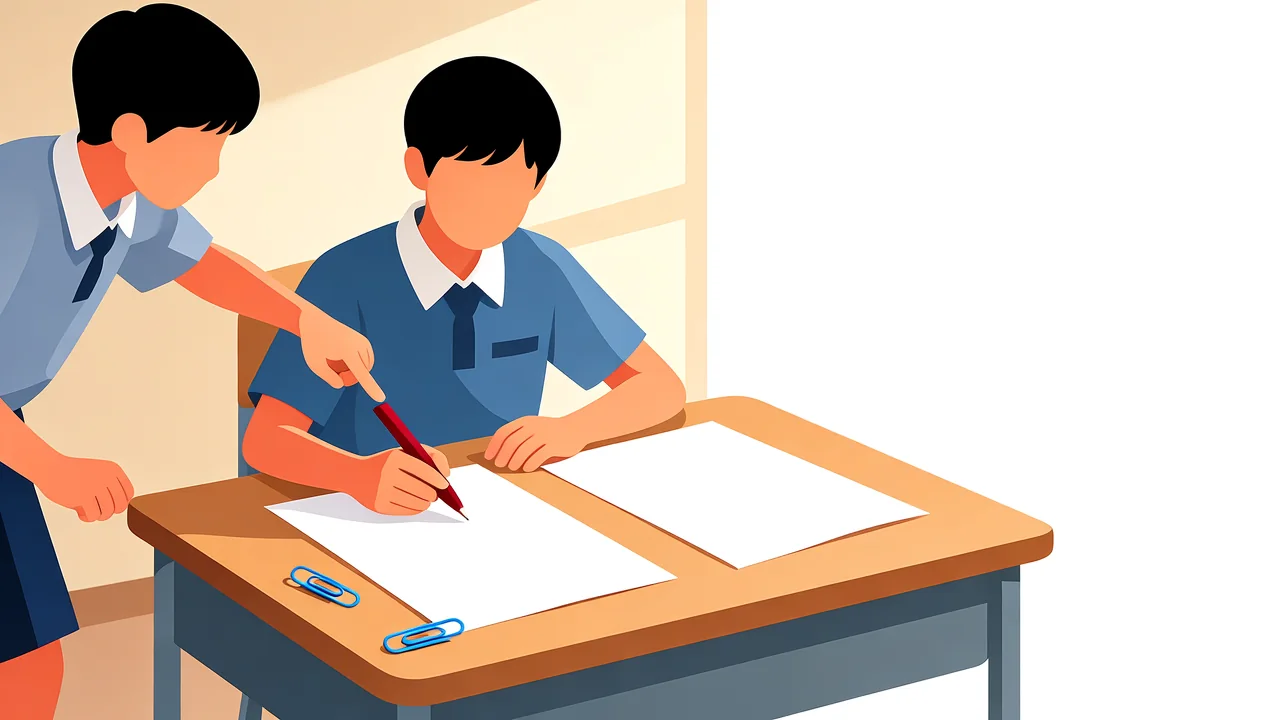
There is one arrangement: first draft on the left, revised draft on the right, paragraph against paragraph. Nothing is recopied, no line spacing is changed, nothing is retyped; the two drafts are the two the pupil already has.
- On the revised draft, mark the changes to be recorded with ① ② ③ ④ ⑤ — three to five, no more and no fewer.
- Mark only changes that change something: a different word, an added condition, a deleted sentence, a reordered clause, an added example.
- Do not mark spelling, punctuation or layout. This page records reasons, not proofreading.
- If one paragraph carries several changes, mark one of them and say in column two which one.
Three to five is a practical number: below two, no choice is visible; above six, pupils start revising in order to fill the sheet, and the record stops being evidence.
2 — The three-column record (fixed)
| Column | What the pupil writes | Length |
|---|---|---|
| 1 — Where | The paragraph and sentence, or the opening words of that sentence | One line |
| 2 — What it became | What it was, and what it is now — both | One sentence |
| 3 — Why | Why this place was changed: would a reader misread it? Was it unclear? Wrong tone? | One sentence |
The rules for the three columns:
- Three columns only, and no fourth. Anything extra is said aloud, or written in the three questions.
- Column one has to be findable. “Third paragraph, second sentence” or “the sentence beginning ‘that day the weather was fine’” both work; “the middle” does not.
- Column two carries both versions. “Changed it” records nothing.
- Column three gives a reason, not a verdict. “A reader would think I was there” is a reason; “better” is not.
3 — The three self-assessment questions (fixed)
The three are fixed: no fourth question, and none dropped:
- “Which place do I most want a reader to see?”
- “Is there anywhere that became less clear after I changed it?”
- “Did the tool suggest a change anywhere? Why did I not adopt it?”
Each does a job. The first makes the pupil name the place that matters most, which is usually the key to the whole piece. The second lets a pupil admit a change went wrong — it must stay, because it turns revision from a gesture that has to succeed into an attempt that is allowed to fail. The third handles the tool’s role: the pupil writes down the suggestion and the reason for refusing it, rather than accepting everything or refusing everything.
The third question asks for a reason, not an evaluation of the tool. “The suggestion made the tone too hard, so I kept my own sentence” is fine; “the tool cannot write Chinese” is not what this page is for.
A prompt has one place on this page: if a pupil asks the tool anything, it is one specific question (“which sentence in this paragraph is least clear?”), and that question is copied under the third answer. No chat record is collected and no screenshot is required.
4 — One peer comparison (15 minutes)
In pairs, read only the other pupil’s three columns — not the drafts, and no marks. With the drafts in view, the conversation becomes “I preferred your first sentence”.
Ask two questions, once each:
- “What is the difference between before and after in this place?”
- “Why did you change this place?”
The listener does two things only: repeat back what they heard, then point out which of the three columns is least clear. No marks, no ranking, no “good” or “bad”, no names read aloud; the record carries class and group only, never a name.
That single round is the whole of the feedback: not a stack of comments, but two specific questions and one repetition back.
5 — The teacher’s checks
- Read the record sheet; collect no drafts and no chat records. Do not ask for, copy or photograph any exchange with a tool, and do not ask for an account or login detail.
- Mark nothing. Check only that the three columns are filled, that column one is findable, that column three gives a reason, and that each of the three questions has one answer.
- Judge nobody’s honesty or originality. The sheet records a process of revision, not whether a pupil used a tool, and it never enters a conduct or examination record.
- Compare no pupil with another. The record carries no name, only class and group, and the peer comparison runs in pairs without reading anyone’s sheet aloud.
- Evaluate no tool, platform or supplier. The tool is always “the tool the school has specified”; no brand, model, supplier, region or institution is named anywhere.
- Never present any of it as a Bureau requirement. The three columns, the three questions, the three-to-five limit and the 60-minute shape are this resource’s suggestion, and a school may adapt them.
- This page covers the primary range only. Both passages quoted come from the Chinese Language Curriculum Guide (Primary 1-6); they do not apply to the secondary curriculum. A secondary class may use the same routine, but the quotations must not be presented as a requirement of the secondary curriculum.
6 — Closing and extension (10 minutes)
The class reads three sentences aloud, as written, with no commentary:
- “I changed this place from ____ to ____.”
- “I changed it because a reader would ____.”
- “The tool suggested ____ and I did not adopt it because ____.”
Two extensions, neither adding a column or a question:
- Use it on the next piece. The next revision gets three to five places, three columns and three questions again.
- Do the second question only. Take an old revised draft, find one place that became less clear, and write one sentence about it.
Answer key and marking notes
The record sheet is not marked, not graded and not ranked. What follows is for the teacher’s demonstration and for circulating round the room; every example is fictional.
A worked pair of drafts and three columns (fictional)
First draft (translated): “On Sunday my family and I went to the park. The park had lots of people. We played for a long time. Then we went home and ate.”
Revised draft: “On Sunday my family and I went to the park. The park was crowded with people flying kites. We played on the grass for two hours, until the sky began to darken, and then went home to eat.”
| Column | Example one | Example two |
|---|---|---|
| 1 — Where | Second paragraph, second sentence, “the park had lots of people” | Third paragraph, “then we went home and ate” |
| 2 — What it became | Was: “the park had lots of people”; now: “the park was crowded with people flying kites” | Was: “then we went home and ate”; now: “until the sky began to darken, and then went home to eat” |
| 3 — Why | The original only said “lots of people”, so a reader could not see who they were or what they were doing; naming the kites gives the scene a picture. | The original had no time in it, so the paragraph gave no sense of how long they stayed; “until the sky began to darken” fixes the order of events. |
The division of labour is clear: column one makes the place findable, column two says what changed, column three says why. Column three is the one most often left blank, and it is the one this page exists to read.
Worked answers to the three questions (fictional)
- The place I most want a reader to see: “The sentence about the park being crowded with kite flyers, because it turns the park from a location into a scene.”
- Anything less clear: “Yes. I joined two short sentences into one long one and it reads breathlessly; if I rewrote it I would put a comma in the middle.”
- Why the tool’s suggestion was not adopted: “The tool suggested rewriting the whole paragraph in the first person. I did not, because this piece narrates something that happened to my family, and the first person would make a reader think I was one of the people there.”
The second answer matters: it shows that admitting a change went wrong is allowed, and is one of the answers this page is asking for.
Common wrong answers and responses
- “Changed it”, with no before and after. Response: “What was it before? What is it now? Write both.” No extra column; just complete column two.
- Column one says “the middle”. Response: “I cannot find it. Give the paragraph and sentence, or copy the opening words.”
- Column three says “better” or “smoother”. Response: “Better in what way? Would a reader misread it? One thing is enough.”
- A sentence-by-sentence comparison of the whole essay. Response: “No need to copy it all out. Three to five places is enough; more than five and we cut back to five.”
- The third question becomes an evaluation of the tool. Response: “This question asks for your reason, not whether the tool is good.”
- A pupil is asked to hand over the chat record. Don’t. This page exists to replace that practice and to collect less pupil data.
Checklist (run through once before the lesson)
- □ The sheet has exactly three columns: where, what it became, why.
- □ The sheet states three to five places only, and not a sentence-by-sentence comparison.
- □ All three questions are present: the place a reader should see, anything less clear, why a suggestion was not adopted.
- □ Nothing asks for a chat record to be handed over, copied or photographed, and nothing asks for an account or login detail.
- □ Nothing carries a mark, grade or rank, and nothing judges honesty or originality.
- □ The sheet has no name field, only class and group, and no name is read aloud in the peer comparison.
- □ No brand, model, supplier, region or institution is named; the tool is always “the tool the school has specified”.
- □ Nothing is presented as a Bureau requirement; the three columns, three questions, three-to-five limit and 60-minute shape are this resource’s suggestion.
- □ The quotations come from the Chinese Language Curriculum Guide (Primary 1-6) and the page says they cover the primary range only.
- □ Every example is fictional, and the page and the sheet both say so.
The point: two drafts side by side, three columns for one change, three questions for one reason. If column three can be written, the page has done its work; if the sheet only says “changed it”, there is a revised draft but no revision.
Files
Two drafts side by side: the three-column record (Word document, editable)
One page, printable on its own, in six parts: the five header items (stage, subject, learning strands, documents, lesson time), how to lay out the two drafts and mark them, the three-column record for three to five places with one fictional example line, the three self-assessment questions, the two questions for one peer comparison, and a one-page checklist. The record sheet has no name field, only class and group. The document carries a version record line in its footer.
Official documents
Every resource in this library is written against the AI Literacy Learning Framework for Primary and Secondary Schools and sits within the policy scope of the Blueprint for Digital Education Development in Primary and Secondary Schools.
This resource maps to:
- Chinese Language Curriculum Guide (Primary 1-6) (2023) (section 5.3.2, assessment activities, item 4, the learning portfolio): the guide asks that the portfolios of upper primary pupils may include first drafts, revised drafts and final drafts of writing exercises, so that pupils monitor their own progress, reflect on and review how well they have learned, and build self-management and self-study skills. This is a primary-range passage only; the two drafts side by side and the three-column record are one way of putting it into practice.
- Chinese Language Curriculum Guide (Primary 1-6) (2023) (Learning Strand 5, Thinking, learning objective 2, developing good thinking qualities, the “discernment” paragraph, p.20): the guide gives as examples distinguishing right from wrong and good from poor in what one hears, identifying and promptly correcting weaknesses when speaking, evaluating and appreciating when reading, and assessing and revising one’s own work when writing. This passage also covers the primary range only; the three self-assessment questions are one way of writing “assessing and revising one’s own work”.
- The 2023 revision of the Bureau’s suggested learning objectives for primary Chinese Language (item 1d, “revision”): that item is a table field, so it is summarised here and no passage is quoted — it asks pupils to review and revise their own writing during the writing process, and the three-column record is that requirement turned into a fillable table.
- AI Literacy Learning Framework for Primary and Secondary Schools: this resource also corresponds to its strands on human-machine communication and collaboration, and reflection on the application of AI.
- Guide to Using AI in Teaching in Primary and Secondary Schools: it sets out principles for learning and teaching; the three questions and the peer comparison keep the feedback inside the classroom.
- Education Bureau Circular No. 156/2026 (Appendix 2, section 4, item 4, the student section): it asks that pupils not follow an AI blindly and learn to verify through several channels; the third question requires a pupil to write why a suggestion was not adopted, and to keep their own sentence and know where it came from.
Learning strands: human-machine communication and collaboration, and reflection on the application of AI
Official documents page: https://www.edb.gov.hk/en/edu-system/primary-secondary/applicable-to-primary-secondary/it-in-edu/debp.html
This page is a teaching resource produced independently by Beets and is not an official EDB document. The name “two drafts side by side”, the three columns, the three questions, the three-to-five limit and the 60-minute time allocation are this resource’s suggestion; a school may adapt them and none of it should be written as a Bureau requirement. Nothing here asks for a chat record to be handed over, copied or photographed; nothing is marked, no judgement of honesty or originality is made, and no pupil is compared with another; the record carries no name, only class and group. No brand, model, supplier, region or institution is named; the tool is always “the tool the school has specified”. Every example is fictional. Both passages from the Chinese Language Curriculum Guide (Primary 1-6) are paraphrased here and quoted verbatim in the Chinese edition; they cover the primary range only and do not apply to the secondary curriculum. The circular passage is paraphrased here in the same way, and quoted verbatim in the Chinese edition.
Feedback
If you have any comments or questions about this resource, or a suggestion for the next one, please tell us on the feedback page.
Related resources
- P4-S6 all subjects: error analysis — when the AI was wrong, how did you find out? (five cells, four error types, three follow-up questions)
- P4-S6 all subjects: better questions — three questions an AI answer did not ask (five lines or fewer, three fixed questions, three columns)
- P4-S6 all subjects: exit tickets an AI cannot answer for you — one sheet, three lines, two minutes, five question types, four piles
- S4-S6 History: AI evidence-trail workshop (three classroom tasks)
Reuse
Download and adapt these resources freely for teaching; please keep the attribution.