
P4-S6 all subjects: exit tickets an AI cannot answer for you — one sheet, three lines, two minutes, five question types, four piles
- StageP4-S6
- SubjectAll subjects / cross-curricular
- Learning strandhuman-machine communication and collaboration / reflection on the application of AI
- Official documentsEducation Bureau Circular No. 156/2026 · Mathematics Curriculum and Assessment Guide (Secondary 4 to 6) · Primary Information and Innovation Technology Curriculum Framework, AI component (trial version) · AI Literacy Learning Framework for Primary and Secondary Schools · Guide to Using AI in Teaching in Primary and Secondary Schools
- Session timeOne lesson (60 minutes; can be split into three 20-minute department meetings)
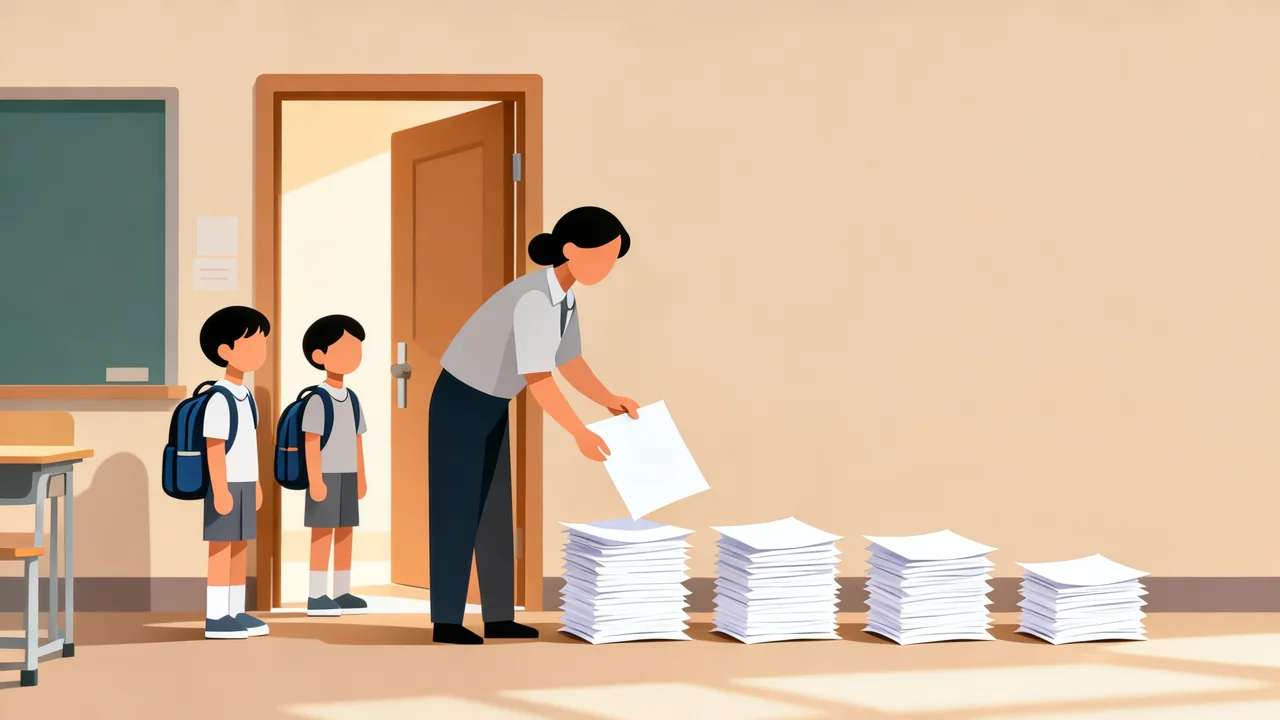
Two minutes before the bell, pupils write three lines on half a sheet of A5: what I understood today, what I am still unsure about, what our group said. The questions come from five types only, at least two types per ticket; the tickets are sorted into four piles in three minutes (got it, half there, teach again, not answered), and the first five minutes of the next lesson answer the teach-again pile only. No name, no score — class and group only.
- EquipmentHalf an A5 sheet per pupil, one five-type question card per group, one copy of the four example sets for the teacher; no device needed
- Version1.1
- Last updated2026-11-19
An exit ticket resists an AI not because the question is hard, but because it asks about something that happened in this room, in this lesson. Someone who was not there cannot write it.
What this solves
The bell is about to go and the teacher wants to know what this lesson actually taught. The convenient move is to set one question and collect the answers — but a question with a standard answer can be written by a tool, and copied by a pupil. What stays invisible is whether the pupil was present: did they notice the change in the experiment, how did they take their own step, what did a group-mate actually say, and which point is still unclear.
An exit ticket is made for exactly this: one sheet, two minutes, collected before the bell. This page narrows it into a shape a tool cannot answer: three fixed line openings, five question types, four piles, and a first five minutes that answers one pile only.
The three line openings are “What I understood today…”, “What I am still unsure about…”, and “What our group said…”. They are sentence frames, not categories: the pupil writes from the opening, and which of the five types the content points at is decided by the question. So one ticket can cross types, and it never turns into three paragraphs of reflection.
The five types are the spine of the page: something that happened in this lesson; one step I took myself; one sentence a group-mate said; an object or a measurement in this room; and the one point I am still unsure about. All five point at the room — this lesson, this classroom, this group. Someone not there cannot answer them, and a tool cannot generate them, because it never saw the lesson.
The four piles are the teacher’s three minutes: got it, half there, teach again, not answered. What is sorted is not a score but the pile to handle next. The first five minutes of the next lesson answer the teach-again pile only: one opening sentence naming the shared error, no names, and no ticket read aloud.
Read the page at three levels. In literacy and framework it corresponds to “human-machine communication and collaboration” and “reflection on the application of AI”. In learning and teaching it is a formative assessment in the last two minutes of a lesson, collecting evidence and feedback rather than a score. In values it exercises critical discernment and reflection: only a pupil who can write down what is still unclear has begun to judge where their own learning stands.
Learning objectives
By the end, pupils can:
- Write three lines on half a sheet of A5, opening with “What I understood today…”, “What I am still unsure about…” and “What our group said…”.
- Draw the content of those three lines from the five types, crossing at least two types and never using one type for all three.
- Include one line from the fifth type, “what I am still unsure about”, naming the point that is still unclear.
- Finish in two minutes: no tool, no talking, no books.
- Write class and group only — no name, no class number, no list of group members.
- Treat the ticket as something that is never scored, never named, never used for conduct or honesty, and never entered in a report card; the tool is always “the tool the school has specified”.
The material corresponds to the “human-machine communication and collaboration” and “reflection on the application of AI” strands of AI literacy. What pupils write is a step they took, a sentence a group-mate said, an object or a measurement in the room — things the tool has never seen, which is why it cannot answer for them. In values it rests on critical discernment: knowing which point is still unclear is where judgement starts.
How to use it
One 60-minute lesson, in six segments: 5 minutes to explain, 15 to demonstrate, 20 for practice, 8 to sort, 7 to close, 5 to count. The order does not change; if time runs short, cut the depth of the demonstration — never a line, never a type, and never merge the piles. The same lesson can be split into three 20-minute department meetings: the first reads the five types and the four example sets, the second tries a ticket and sorts it, the third reads the counts from four lessons.
| Time | Segment | What happens |
|---|---|---|
| 5 min | Explain | Hand out the ticket sheets, read the three openings once, and state two minutes, no names, no score. |
| 15 min | Demonstrate | Using one part of this lesson, show how three questions fall into different types. |
| 20 min | Practice | Two minutes a round, two practice tickets; the second round opens with a different type. |
| 8 min | Sort | Three minutes to sort the tickets into four piles; the rest of the time reads the counts. |
| 7 min | Close | Explain how the first five minutes of the next lesson answer the teach-again pile. |
| 5 min | Count | The teacher records the four pile counts only — no names, no group lists. |
1. One sheet, two minutes, three lines
- Half a sheet of A5, three lines, with the openings already printed: “What I understood today…”, “What I am still unsure about…”, “What our group said…”.
- Two minutes: it starts two minutes before the bell and stops when the bell goes; a line left unfinished stays empty and is not completed later.
- No tool, no talking, no books: those two minutes hold only what the pupil remembers.
- Class and group only: no name, no class number, no list of group members.
- The tickets go into four piles on the floor by the door, placed by the pupils themselves; the teacher does not read them one by one.
2. Five types of question (five only)
The order does not change, and there are five:
| Type | What the question asks about | What the pupil writes |
|---|---|---|
| 1 | Something that happened in this lesson | One thing done, said or seen in this lesson |
| 2 | One step I took myself | The step I took: what I did first |
| 3 | One sentence a group-mate said | One sentence a group member said |
| 4 | An object or a measurement in this room | One object, one measurement or one change in the classroom |
| 5 | What I am still unsure about | The one point I have not understood |
No sixth type is added. The rules for the three lines:
- At least two types, and never all three from one type.
- One line of the fifth type every lesson: every ticket carries a line saying what is still unsure.
- Four lessons running, the first line does not open with the same type: the opening type rotates, and only repeats after four lessons.
- Questions point at the room only: anything a tool could also answer (a definition, a formula, a standard answer) is not one of the five.
- The three openings are sentence frames, not categories; the same opening can carry content from different types.
3. Four example sets (three each, twelve in all)
The examples are a starting point, and a teacher may rewrite them for their own subject; one condition survives the rewrite: they point at the specific room this lesson happened in. All twelve below are fictional.
| Set | Question (copy the wording) | Type |
|---|---|---|
| Chinese Language | What I understood today… the last sentence of paragraph three is where the whole text turns. | 1 |
| Chinese Language | What I am still unsure about… why the writer uses one connective here rather than the other. | 5 |
| Chinese Language | What our group said… if paragraph one were removed, the story would still read. | 3 |
| Mathematics | What I understood today… my first step was to draw the diagram, then write the expression. | 2 |
| Mathematics | What our group said… the same expression can be written by two methods. | 3 |
| Mathematics | What I am still unsure about… why the unit is written in square centimetres. | 5 |
| Science and General Studies | What I understood today… the drops outside the ice cup are water vapour in the air condensing. | 4 |
| Science and General Studies | What I am still unsure about… why the drops appear on the outside of the cup and never on the inside. | 5 |
| Science and General Studies | What our group said… with the lid on, there would be fewer drops. | 3 |
| Art and Physical Education | What I understood today… for the dark part, the pencil is used on its side. | 2 |
| Art and Physical Education | What our group said… after the formation went from three rows to two, nobody collided on the turn. | 3 |
| Art and Physical Education | What I am still unsure about… why the same movement is harder when it is done slowly. | 5 |
Three per set, each set crossing at least two types, and each set carrying one line of the fifth type. To rewrite one, a teacher swaps in this lesson’s object, this step, this sentence — and invents no new type.
4. Three minutes to sort, and the first five minutes of the next lesson
After collection, three minutes to sort the tickets into four piles, with no comment, no score and no name:
| Pile | What it means | What the first five minutes of the next lesson do |
|---|---|---|
| Got it | All three lines are specific, including the fifth type | Nothing; the pile is not read out |
| Half there | Specific, with one vague point | One group-mate explains it once; no extra sheet |
| Teach again | All three lines stay on the surface, or the fifth type is missing | One opening sentence naming the shared error, no names, no ticket read aloud |
| Not answered | One line is empty, or the whole ticket is blank | Collect again at the same point next lesson, with no follow-up question |
Four piles, and only four: no merging, no fifth pile. The first five minutes of the next lesson answer the teach-again pile only:
- One opening sentence naming the shared error: the pile’s common mistake is stated once, with no name and no ticket read out.
- Half there: one group-mate explains it once, with no extra sheet and no second ticket.
- Not answered: collect again at the same point of the next lesson, ask for no reason and record nothing.
- Got it: nothing; not read out, not praised, not compared with another pile.
5. Closing and follow-up
The proportions of the four piles are recorded as counts only, for four lessons running: each lesson the teacher writes how many tickets sit in each pile, on their own sheet, with nothing beyond the class recorded. In the fifth lesson, one question changes.
- In the fifth lesson, change one question only: the counts show which type is weakest, and only that type’s wording changes.
- The five types, three lines and four piles stay fixed: one variable at a time, so that four lessons later the difference can be seen.
- Follow-up one: turn the teach-again pile’s shared error into the opening sentence of the next lesson and keep it on the teacher’s desk.
- Follow-up two: at the end of a term, lay the four sets of counts side by side once, only to decide whether the next unit needs two more minutes.
6. How this page divides the work with five others
This page does the two minutes on paper, and it takes the whole class. Five other pages do related work; a teacher picks one of them, not all of them.
| Page | What it does | How it differs from this page |
|---|---|---|
| ten-minute-ai-judgement-checks | Judges in ten minutes whether a tool’s answer can be trusted | This page judges no tool; it collects what the pupils wrote about the room |
| better-questions-from-ai-answers | Puts three questions the tool’s answer did not ask | This page asks about what happened in this lesson, not about a tool’s sentence |
| ai-error-discovery-log | Finds the errors in a tool’s answer and records them in five boxes | This page looks for no error, and no tool is available in these two minutes |
| student-ai-use-process-sheet | The pupil records the first attempt, the prompt, the check and the revision | This page collects three lines only, with no name on the ticket and no running record |
| oral-check-explain-the-idea | The teacher takes three minutes orally with four to six pupils and puts three levels to one sentence | That page takes one pupil at a time, four to six a lesson; this page takes the whole class on paper in two minutes |
Answer key and marking notes
The exit ticket is not scored, not levelled and not ranked, so there is no answer key here — only the difference between a line that is specific and a line that stays on the surface. What follows is what a teacher can use while demonstrating and sorting; every example is fictional.
Specific and on the surface
| Specific (got it, or half there) | On the surface (teach again) |
|---|---|
| What I am still unsure about… why the writer uses one connective here rather than the other. | What I am still unsure about… I do not get it. |
| What our group said… with the lid on, there would be fewer drops. | What our group said… we said a lot of things. |
| What I understood today… for the dark part, the pencil is used on its side. | What I understood today… drawing is hard. |
There is one check for a line: does it point at the specific room this lesson happened in? If it does, it is evidence; if it does not, it is a remark.
Common wrong turns and what to say
- Three lines of general reflection. Say: “The three openings are frames. Which of the five types is your line pointing at?”
- All three lines from one type. Say: “At least two types. Could your second line say what you are still unsure about?”
- The fifth type left empty. Say: “The fifth type is on every ticket. One point you have not understood is enough.”
- A standard answer written out. Say: “A tool could answer that. Write one sentence your group said, or one step you took.”
- Asking pupils to hand over a chat record. Do not: this page collects the ticket itself, not a draft, not a chat record and not a screenshot.
Checklist (run through once before the lesson)
- □ The ticket is half a sheet of A5 with three lines, and the openings are already printed.
- □ All five types are present, in order: what happened in this lesson, one step I took, one sentence a group-mate said, an object or measurement in the room, what I am still unsure about.
- □ Every ticket crosses at least two types and carries one line of the fifth type.
- □ There are four piles and only four: got it, half there, teach again, not answered.
- □ Nothing anywhere asks for a chat record, a screenshot or a pupil’s own draft to be handed over, uploaded or photocopied.
- □ Nothing is scored, levelled or ranked, nothing judges conduct or honesty, and nothing enters a report card.
- □ The ticket has no name field, only class and group.
- □ No brand, model, supplier, institution, country or city is named; the tool is always “the tool the school has specified”.
- □ Nothing is written as a Bureau requirement, and nothing is written as a plagiarism check or an honesty review.
- □ Every example is fictional, and the page says so.
- □ The stage limit of each passage is stated where it is quoted: the circular covers the whole range, the mathematics guide covers Secondary 4 to 6 only, the primary framework covers Primary 1 to 6 only.
The core is three lines, five types, four piles. If the three lines point at this lesson, the ticket has done its work; three tidy lines that point at nothing are a copying exercise.
Files
The ticket sheet, the five-type question card and the four example sets are in the download; each prints on one side and can be photocopied on its own:
Ticket sheet, five-type question card and four example sets (editable Word document)
Every example is fictional and involves no real pupil, school or lesson.
Official documents
Every resource in this library is written to the AI Literacy Learning Framework for Primary and Secondary Schools and falls within the policy scope of the Blueprint for Digital Education Development in Primary and Secondary Schools.
This resource maps to:
- Education Bureau Circular No. 156/2026 (Appendix 2, the digital education teacher information pack, part 3, learning and teaching: the shift in classroom and assessment practice): the circular asks schools, when teaching with AI, to apply AI across the learning, teaching and assessment of every subject and to move the model of teaching towards personalised, pupil-centred learning. This page puts that on one sheet for two minutes: it asks what this pupil saw in this lesson. This passage covers the whole range, P4-S6.
- Mathematics Curriculum and Assessment Guide (Secondary 4 to 6) (section 5.2, formative assessment): the guide describes formative assessment as finding out what pupils have learned and measuring their progress, using the feedback to plan the next learning and teaching activities, and notes that it can be built into ordinary classroom activity in various forms — observing pupils, class discussion, oral reporting, project work, classwork and homework. This page’s four piles are one such formative assessment, collecting feedback and evidence rather than a score. This passage covers Secondary 4 to 6 only; used with P4-S3 it is a learning-and-teaching principle, and must not be written as a requirement for that stage.
- Primary Information and Innovation Technology Curriculum Framework, AI component (trial version) (the section on promoting AI education at primary level): schools should guide pupils to understand that AI is only an auxiliary tool, and through the learning content of technology education (information and communication technology) and its use in different subjects, across subjects and across domains, encourage pupils to think actively, to build critical discernment and correct values, and to avoid over-reliance on AI that amounts to outsourcing their thinking. The exit ticket is one way of avoiding that outsourcing: for two minutes there is no tool to use. This passage covers Primary 1 to 6 only; used in a secondary class it is likewise a principle, and this page does not claim it covers the secondary years.
- AI Literacy Learning Framework for Primary and Secondary Schools: named only, with no passage quoted here; it sets out the three learning strands, and this page corresponds to “human-machine communication and collaboration” and “reflection on the application of AI”.
- Guide to Using AI in Teaching in Primary and Secondary Schools: named only, with no passage quoted here; it sets out principles for learning and teaching, and the three lines, five types and four piles are one way of turning those principles into two minutes before the bell.
Stage coverage: Education Bureau Circular No. 156/2026 covers the whole range, P4-S6; the Mathematics Curriculum and Assessment Guide covers Secondary 4 to 6 only; the AI component of the Primary Information and Innovation Technology Curriculum Framework (trial version) covers Primary 1 to 6 only. This page does not claim that any one of them covers the whole of P4-S6.
Learning strands: human-machine communication and collaboration / reflection on the application of AI
Official documents page: https://www.edb.gov.hk/en/edu-system/primary-secondary/applicable-to-primary-secondary/it-in-edu/debp.html
This page is an independent Beets teaching resource, not an official EDB document. “Exit ticket”, the three openings, the five types, the four piles and the 60-minute shape are this resource’s suggestion; a school may adapt them, and none of it should be written as an Education Bureau requirement or as a plagiarism check or an honesty review. Nothing here asks for a chat record, a screenshot or a pupil’s own draft to be handed over, uploaded or photocopied; only the ticket itself is collected. Nothing is scored, named, judged for conduct or honesty, entered in a report card or compared between pupils; the ticket carries class and group only. No brand, model, supplier, institution, country or city is named anywhere, and the tool is always “the tool the school has specified”. Every example is fictional. The AI Literacy Learning Framework for Primary and Secondary Schools and the Guide to Using AI in Teaching in Primary and Secondary Schools are named here only, with no passage quoted. The passages above are given in full in the Chinese edition, because these documents are published in Chinese; this edition reports what each one requires. The circular’s passage covers the whole range; the Mathematics Curriculum and Assessment Guide passage covers Secondary 4 to 6 only; the Primary Information and Innovation Technology Curriculum Framework passage covers Primary 1 to 6 only, and all three limits are stated in the page.
Feedback
If you have any comments or questions about this resource, or an idea for the next one, tell us on the feedback page.
Related resources
- P4-S6 all subjects: error analysis — when the AI was wrong, how did you find out? (five cells, four error types, three follow-up questions)
- P4-S6 all subjects: better questions — three questions an AI answer did not ask (five lines or fewer, three fixed questions, three columns)
- S4-S6 History: AI evidence-trail workshop (three classroom tasks)
- Homework redesign kit: two before-and-after assignments that show student thinking (P4-P6)
Reuse
Download and adapt these resources freely for teaching; please keep the attribution.