P4-S6 cross-subject: two answers to one question — which is more dependable, and why
- StageP4-S6
- SubjectCross-subject
- Learning strandreflection on the application of AI (single)
- Official documentsEDBCM No. 156/2026 · Primary Information and Technology Curriculum Framework (AI component, pilot edition) · The same framework
- Session timeOne 60-minute lesson; about 15 minutes to prepare the two answers
One question, answered twice by the tool the school has designated, with the two answers labelled only A and B. Three checks, once each: a sentence that can be checked, a sentence that cannot, and one place where the two conflict; then one sentence of verdict that must also say what is still uncertain. The teacher does not announce which one is right.
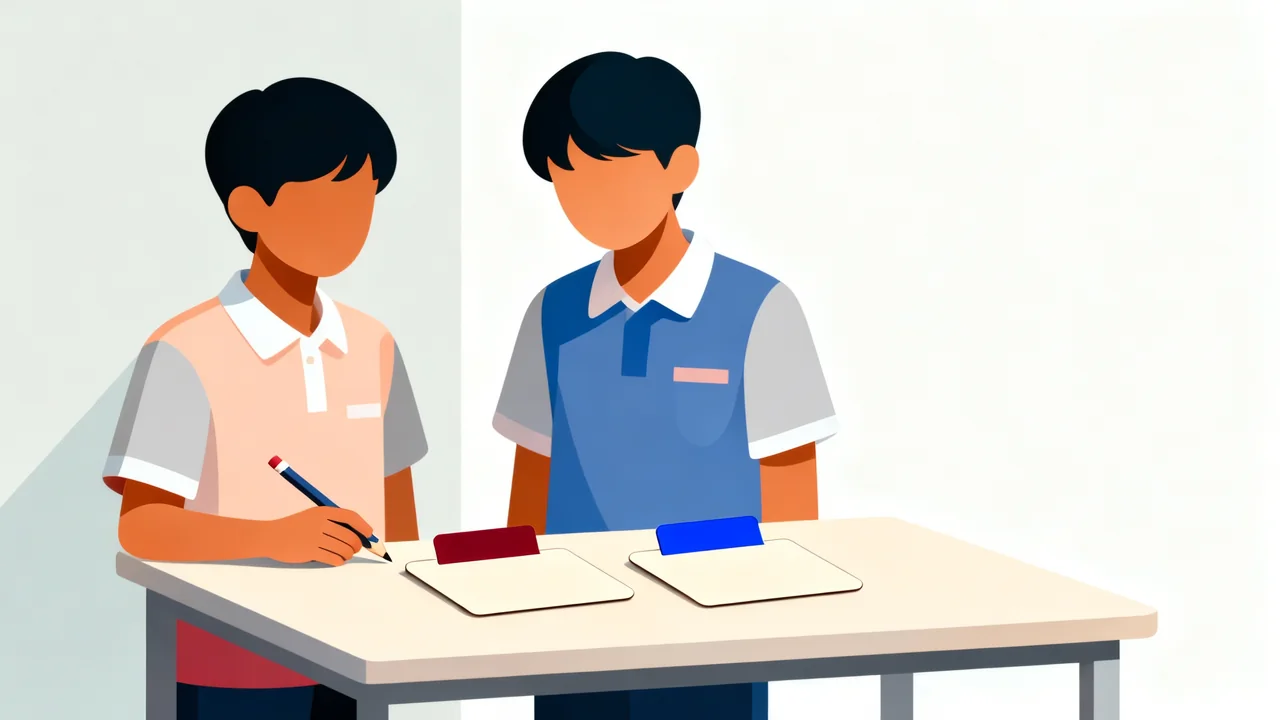
- Equipmenttwo answers prepared by the teacher, five to eight sentences each and fictional if need be (one set per group, A and B); a three-item check sheet per pupil; a verdict card per pupil; no device, and pupils do not open a tool
- Version1.0
- Last updated2026-11-23
Two answers lie on the table, labelled only A and B. This page does not ask which one is right; it asks which is more dependable, and why.
What this solves
The first thing pupils ask is “which one is right”. In a classroom that question usually cannot be answered: both answers may contain errors, or one may be right about half and the other about the other half, and the teacher has no answer key to check against on the spot. What can be taught is a different question — which of the two is more dependable, and on what grounds.
This page asks for three visible things: name the sentences that can be checked, name the sentences that cannot, and find the one place where the two answers disagree; then write a verdict in one fixed sentence that must include what the pupil is still unsure about. That last part is the point of the page: “I think A is more dependable” is easy to write; “but I am still unsure about…” is what shows that a pupil knows where he is standing.
Three checks, once each — there is no need to label a whole answer sentence by sentence. The order is fixed: first the checkable sentences, then the uncheckable ones, and only then the place where the two conflict. Change the order and pupils reach a conclusion first and look for support afterwards.
One verdict is one sentence, in a fixed form, with nothing added. Verdicts may differ within a group; this page does not look for one class answer, and the teacher reads out only the “still unsure” column.
One sentence checked gives the last part of the lesson to real verification work: the pupil chooses one sentence and writes where he would check it, what he found, and whether the sentence needs changing. If it cannot be checked in this lesson, he writes “not found in this lesson” — he does not pretend to have checked.
Three things to read first:
- The names “three checks” and “one verdict” are this resource’s suggestion; the Education Bureau’s documents do not use them and prescribe neither the number of checks nor the sentence form. The basis is what those documents do require — verifying information, cross-checking, and critical thinking; this page turns those requirements into three items and one sentence a single lesson can finish.
- This page is not marked, is not an oral test, enters no mark book, and compares no pupil with another. Pupils are never asked to hand in, upload or photocopy a conversation record, a screenshot, the text of an answer or account details; the checks and the verdict stay on paper.
- The three passages quoted on this page do not all cover the same stages. The first comes from an Education Bureau circular and covers every stage, primary and secondary. The second and third come from the AI component of the Primary Information and Technology Curriculum Framework (pilot edition), which covers Primary 1 to Primary 6 only. This page is for P4-S6, so the secondary years borrow only its principles of verification and reflection.
This page does not conclude which answer is right, and it passes no judgement on any tool. It has one conclusion: how dependable an answer is depends on how much of it can be checked, how much cannot, and where it disagrees with the other one.
Learning objectives
By the end, pupils can:
- Name the three checks, in order, and carry out each of them once.
- Point to at least one sentence in an answer that can be checked, mark it, and say why it can be checked.
- Point to at least one sentence that cannot be checked, mark it “no source”, and say why — rather than writing “wrong”.
- Find one place where the two answers disagree, copy both sentences into the same cell, and write “no clear conflict in this question” when there is none.
- Write one verdict in the fixed form, with the second blank filled by something they are still unsure about.
The page addresses reflection on the application of AI as a single strand — the page contains no human-machine dialogue at all, so human-machine communication and collaboration is not added alongside it. Three values are practised at once: critical thinking means not treating “it reads smoothly” as “it can be trusted”; responsibility means writing down the point one is still unsure about instead of hiding it; using technology at the right time means knowing which sentence is worth the time to verify and which would repay nothing. The three checks and the one verdict together turn reflection into two lines on paper that can be seen.
How to use it
One 60-minute lesson, five fixed parts: the two answers, the three checks, the one verdict, the one sentence checked, and closing with extension. There are three checks and no more, and one verdict and no more; nothing is added or dropped, and no sub-item is invented. The tool is always written as “the tool the school has designated”, and no brand, model, version or service appears on this page.
1 Two answers, not two tools
One question is answered twice by the tool the school has designated, and the two answers are written out on two sheets, A and B. This step only prepares the material; no tools are compared.
- The answers carry only “A” and “B”. No tool name, date or time; nothing on the sheets should let a pupil work out which answer came second.
- No brand, model or version is compared. The difference between the two is in the content, not in where it came from.
- Both may contain errors. This page does not conclude which is right; one right about half and the other about the other half is the commonest case, and the most useful one to discuss.
2 The three checks (three, in this order)
Each is done once; there is no need to label a whole answer. Do the first, then the second, and only then the third.
| Check | What to look for | What to write |
|---|---|---|
| 1 · A sentence that can be checked | A number, a date, a name, or a source that can be named | One word beside it: “check”. Not where to check it |
| 2 · A sentence that cannot be checked | Only a feeling, a promise, a prediction, or a claim with no source | “No source” — three words. Not “wrong” |
| 3 · One place where the two conflict | The two answers disagree on the same point | Copy both sentences into the same cell, one against the other |
- “Cannot be checked” is not “wrong”. A sentence with no source may simply not need one; what the pupil writes is “no source”, not a verdict of error. A tool that states something it does not have is what is usually called a hallucination; this page does not ask pupils to identify one, only to note that the sentence has no source.
- If there is no conflict, write “no clear conflict in this question”. Do not manufacture one; two answers that agree are a valid result.
- A conflicting pair does not prove that one of them is wrong. Both may be incomplete; the pupil only has to name the two sentences that do not line up.
3 One verdict (one fixed sentence, nothing added)
One verdict card per pupil, one sentence only. The form is fixed:
I think A / B is more dependable, because ___; but I am still unsure about ___.
- The first blank holds a reason that can be pointed at — for example “one sentence in it can be checked”, “it does not use the word ‘must’”, or “on the point where they disagree, the other one is more specific”.
- The second blank must be filled. It holds something the pupil is still unsure about; “I don’t know” is acceptable, a blank is not.
- No “certainly”, no “definitely”, no “completely right”, and no marks or levels. A verdict is a judgement, not a ruling.
- One sentence only; anything beyond it is not counted. Verdicts may differ within a group, and the teacher reads out only the “still unsure” column, never which answer was preferred.
4 One sentence checked
Choose one sentence from the second check — one that cannot be checked — or from the first, one that can. Either is allowed, but only one. Three cells, carried into the next lesson or set as homework.
| Cell | What goes in it |
|---|---|
| Where I would check it | One specific place — a textbook, a map, a category of official website. Not “online” |
| What I found | If it cannot be checked in this lesson, “not found in this lesson”; never pretend to have checked |
| Does the sentence need changing? | “Change it”, or “leave it” — one of the two |
- One sentence only this lesson. The rest is homework; one sentence checked properly is worth more than five half-checked.
- The teacher does not check it for them and does not demonstrate a search. The teacher confirms the three cells are filled and gives no answer.
- “Not found in this lesson” is a valid result. Looking and failing to find is a different thing from not looking, and the paper can tell them apart.
5 Closing and extension
The 60 minutes are allocated as follows; six segments, 60 minutes in all.
| Time | What happens |
|---|---|
| 8 min | Opening and handout: the two answers, the check sheet, the verdict card; the labelling is explained |
| 10 min | Read both answers and do check 1: write “check” beside the sentences that can be checked |
| 12 min | Do checks 2 and 3: write “no source”, then find one place where they conflict |
| 10 min | Each pupil writes one verdict, with no discussion yet |
| 10 min | One sentence checked: fill the three cells |
| 10 min | Closing: the teacher reads out several “still unsure” lines, and the class reads the three closing sentences |
Three closing sentences (read together):
- “This sentence can be checked.”
- “This sentence has no source.”
- “I am still unsure about this point.”
Extension: a third answer to the same question next lesson. One task is added: find where the two answers are both right, and write it as one sentence. The three checks are not redone and the verdict is not rewritten — the third answer only answers “which sentence are both right about”.
Where this joins other resources
| Resource | What that page does | How this page divides the work with it |
|---|---|---|
| Peer critique with AI output as a shared object | The class judges whether one output stands up, and settles it with a vote | This page only compares where two answers differ: no single output is judged and nothing is voted on |
| Source-trail map: claim, source, how you verified it | Traces one claim to its source and asks for two independent sources | This page checks one sentence only: it does not trace a trail or set up a procedure |
| Hallucination hunt: a repeatable multi-source procedure | Builds a multi-source procedure that can be repeated | This page notes “no source” and builds no procedure |
| Better questions: three questions an answer did not ask | Grows three questions out of one answer | This page asks no new questions; it judges which answer is more dependable |
| Two-draft comparison: what changed, and why | Compares a pupil’s own two drafts and explains the changes | This page compares two tool answers and makes no revision suggestions |
Answer key and marking notes
The three checks, filled in (entirely fictional, to show the format)
| Check | What the pupil wrote |
|---|---|
| 1 | Beside A’s third sentence, “begins on a stated date”: “check” — it contains a date, so it can be checked |
| 2 | Beside B’s last sentence, “this will always work best”: “no source” — a claim with no source, and no indication of the case it applies to |
| 3 | A says “only S3 to S6”, B says “all year groups”; both sentences copied into one cell, one against the other |
Two verdicts (fictional; one valid, one not)
- Valid: “I think B is more dependable, because A’s sentence names the year and can be checked; but I am still unsure whether B’s ‘all year groups’ includes S1 and S2.”
- Not valid: “I think A is definitely right because it explains things clearly.” — it uses “definitely”, gives no reason that can be pointed at, and leaves the “still unsure” part empty.
Common wrong answers:
- “Cannot be checked” written as “wrong”. Response: no source only means the sentence has none; what has to be written is “no source”.
- Half a verdict. Response: the form has two blanks and the second one is required; the “still unsure” part is the point of the page.
- Two or three sentences of verdict. Response: one sentence only; anything more is not counted.
- A conflict manufactured to order. Response: write “no clear conflict in this question”; two answers that agree are a valid result.
What counts as finished: each of the three checks done once (the third may say “no clear conflict”), one verdict with both blanks filled, and all three cells filled (the second may say “not found in this lesson”). Finished is judged on whether it is written: it is not marked, not an oral test, and enters no mark book, and no pupil is compared with another.
Files
Two answers to one question: three checks and one verdict (editable Word document)
Six sections, each to be copied on its own: the five header facts, how to prepare the two answers with a fictional example, the three-item check sheet (one per pupil), the verdict card (one per pupil, with the sentence already printed), the three-cell sheet for the one sentence checked, and a 60-minute sequence with a one-page review checklist.
Each file carries a version record in its footer.
Official documents
Every resource in this library is written to the AI Literacy Learning Framework for Primary and Secondary Schools and falls within the policy scope of the Blueprint for Digital Education Development in Primary and Secondary Schools; the teaching decisions are the teacher’s, as the Guide to Using AI in Teaching in Primary and Secondary Schools asks.
This resource maps to:
- EDBCM No. 156/2026, Appendix 2, the digital-education teacher information pack, section 4 for students, “literacy first, technology for good”, under the item on building the ability to think critically and distinguish: the circular says that pupils must not follow AI blindly, must learn to cross-check from several directions, and must be able to identify errors and false information, including the risks that come with deepfake technology. This passage covers every stage: the circular applies to primary and secondary schools, and the three checks and one verdict are one classroom way of doing the cross-checking it asks for.
- Primary Information and Technology Curriculum Framework (AI component, pilot edition), in the section on holding to a people-centred, technology-for-good spirit: on verifying that information is correct, it asks pupils to learn to verify and fact-check, notes that an answer from AI is not necessarily all correct, and says that unverified information should not be used or passed on casually. This passage covers Primary 1 to Primary 6 only, because it comes from the primary framework.
- The same framework, the closing paragraph of the section on learning and applying AI: it says that schools design inquiry-based learning and teaching so that pupils, while using AI, reflect on its limits and effects and so build a responsible and active learning attitude. This passage also covers Primary 1 to Primary 6 only.
Learning strand: reflection on the application of AI (single)
A note on curriculum wording: the three passages above do not cover the same stages, and the page and the attachment say so for each one. The first comes from Appendix 2 of EDBCM No. 156/2026 and covers every stage; the second and third come from the AI component of the Primary Information and Technology Curriculum Framework (pilot edition), a primary pilot covering Primary 1 to Primary 6 only. This page is for P4-S6: the secondary years borrow only the principles of verification and reflection, and nothing here presents the framework as a secondary requirement. The AI Literacy Learning Framework and the Guide to Using AI in Teaching are named on this page only; none of their wording is quoted, and no learning focus, unit or level name of theirs is filled in here.
Official documents page: https://www.edb.gov.hk/en/edu-system/primary-secondary/applicable-to-primary-secondary/it-in-edu/debp.html
This page is an independent Beets teaching resource, not an official EDB document. The names “three checks” and “one verdict”, together with the number and order of the checks and the form of the sentence, are this resource’s suggestion and not an Education Bureau requirement. This page passes no judgement on any tool, does not conclude which answer is right, is not marked, is not an oral test and compares no pupil with another. Every answer and example on the page and in the attachment is fictional, with no real school, class, teacher or pupil; pupils are never asked to hand in, upload or photocopy a conversation record, a screenshot, the text of an answer or account details.
Feedback
If you have any comments or questions about this resource, or an idea for the next one, tell us on the feedback page.
Version record: 1.0 built (2026-11-23)
Related resources
- P4-S6 all subjects: error analysis — when the AI was wrong, how did you find out? (five cells, four error types, three follow-up questions)
- P4-S6 all subjects: better questions — three questions an AI answer did not ask (five lines or fewer, three fixed questions, three columns)
- P4-S6 all subjects: exit tickets an AI cannot answer for you — one sheet, three lines, two minutes, five question types, four piles
- S4-S6 History: AI evidence-trail workshop (three classroom tasks)
Reuse
Download and adapt these resources freely for teaching; please keep the attribution.