
P4-S6 cross-subject: group thinking roles in an AI task — asker, checker, challenger, recorder
- StageP4-S6
- SubjectCross-subject
- Learning strandhuman-AI communication and collaboration / reflection on the use of AI
- Official documentsBlueprint for Digital Education Development in Primary and Secondary Schools · AI Literacy Learning Framework for Primary and Secondary Schools · Guide to Using AI in Teaching in Primary and Secondary Schools · Chinese Language Curriculum Guide (Primary 1-6) (2023) · Visual Arts Curriculum Guide (Primary 1 to Secondary 6) (2024) · EDB Circular Memorandum No. 156/2026
- Session timeOne 60-minute lesson; prepare one task card beforehand and print the four role cards and the record sheets
One task split into four steps, one step each: the asker writes the question as a single sentence, the checker opens a source, verifies one item and records where it was seen, the challenger names one checkable alternative, and the recorder reads back one line from each of the other three. One lesson, one round, and everyone writes the role they want to try next.
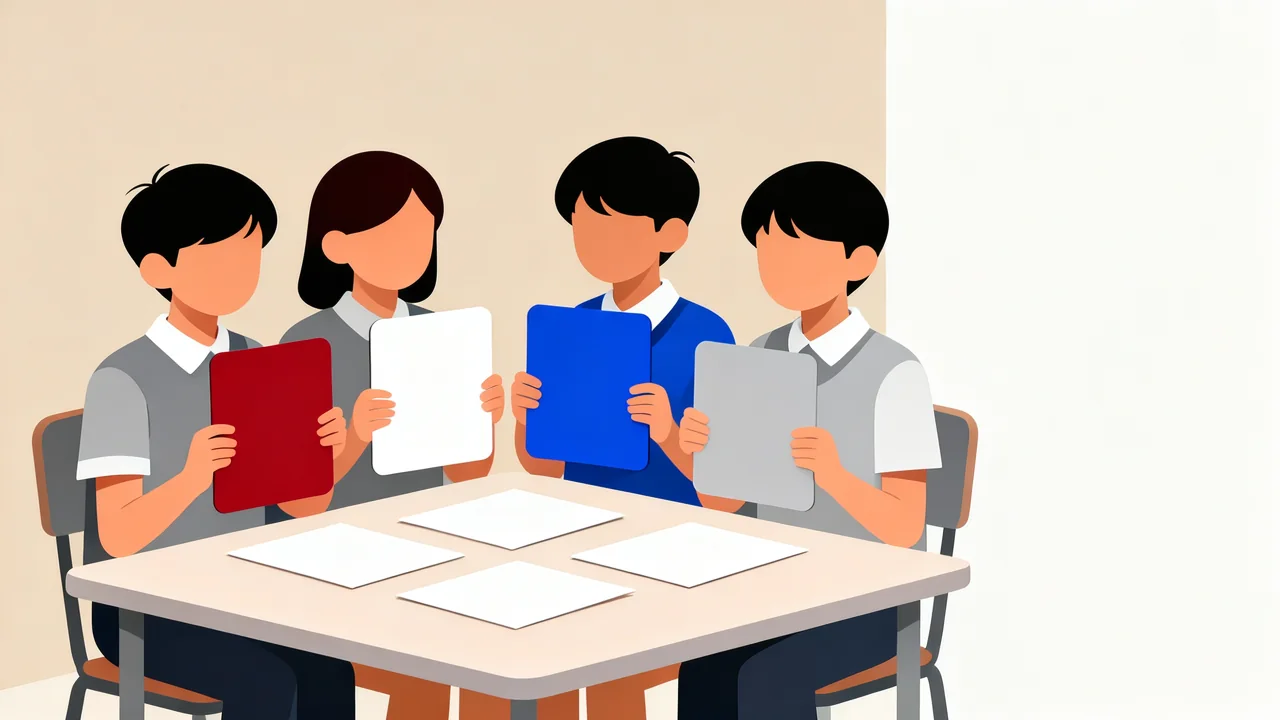
- EquipmentA set of four role cards per group; one five-column record sheet per pupil; one task card (teacher-prepared, fictional content); one school-approved tool shared by the group
- Version1.0
- Last updated2026-11-26
The roles on this page are four steps inside the task, not class posts, and not a grading of ability.
What this solves
Start with the familiar arrangement: a group does a task with a tool, and one pupil types while the other three watch. What is handed in belongs to the group, but only one person thought it through. The teacher sees a finished product and cannot see whether the other three judged anything the tool wrote. A tidy product does not say who made it tidy.
The second gap is in what “divide the work” usually means. In a classroom it tends to mean “you find the material, you type, you report”: it divides the workload, not the steps of thinking. Workload can be divided; judgement cannot be done for someone else — if the checking step is done in passing by the person who is typing, there has been no checking. That is the line this page keeps: of the four steps, ask, check, challenge and record, steps two to four are not done by the tool.
The third gap is in the record. When the group task ends, what stays in the exercise book is a product; who asked what, who verified which item, who raised an alternative — none of it stays. To assess a group, the teacher has only the product. So in the record, “group work” comes to mean “somebody did it”, and human-ai collaboration comes to mean “somebody used a tool”.
This page does one thing only: four roles, one round, five columns. It does not teach tool operation, does not mark answers right or wrong, does not rank, does not appoint a group leader, does not handle group conflict, and never asks for tool output or screenshots to be handed over.
There is another page in this library that uses the word “roles” for who has to account for an event afterwards — teacher, pupil, parent, tool provider, school. That page comes after an event; this one sits inside the task: its four roles are the four steps four pupils each take in this round. Both use role cards, for opposite purposes, and a department that takes only one of them is missing the other.
Learning objectives
By the end of the lesson, pupils can:
- Name the four roles and say which step their own role card asks them to take.
- Narrow what they want to ask the tool into one sentence, asking one thing only, and state which item they are looking for.
- Open a source they can see themselves, verify one item, and record where it was seen (page number, kind of official web page, date consulted).
- Offer one checkable alternative, written as “what would happen if …”, rather than “I think it is wrong”.
- Read back one line from each of the other three, confirm nothing was distorted, and write in column five which role they want to try next round.
The page addresses the strands human-AI communication and collaboration and reflection on the use of AI: within one task, who does which step has to be writable, and “which item I verified” is the most concrete form of reflection. Three values are practised. Critical thinking asks “can I verify this sentence” before deciding to use it. Human-AI collaboration puts the tool in step two and keeps it out of the checking in step three. Timely and appropriate use is knowing which step is worth stopping at to cross-check, and which step can simply be done.
How to use it
One 60-minute lesson, one round of four steps, in a fixed order. There are four roles and five columns; nothing is added, removed or given sub-items.
1. The four roles (fixed at four)
| Role | What this step does | What it may not do |
|---|---|---|
| Asker | Writes what the group wants to ask the tool as one sentence; one thing per sentence, and states which item is being looked for | May not paste the whole assignment and ask “how do I do this” |
| Checker | Names one item to check, opens a source they can see themselves, and records where it was seen (page number, kind of official web page, date consulted) | May not leave a blank when nothing can be found — write “not found” |
| Challenger | Offers one opposite or alternative possibility, written as “what would happen if …”, and it must be a checkable claim | May not write only “I think this is wrong” |
| Recorder | Reads back one line from each of the other three once, confirming nothing was distorted | May not add an opinion of their own to the record |
Two sentences to remember: the four roles do not rotate within a lesson — each pupil takes one; and the four roles carry no rank. Timing and handing out paper are agreed by the group itself and are not a fifth role.
2. The four steps of one round (fixed order)
| Step | Time | What happens |
|---|---|---|
| 1. Read the task and divide | 3 min | Each of the four takes their own role card and writes down the step they will do this round |
| 2. The asker asks | 6 min | The asker writes the question as one sentence and gives it to the tool; the other three say nothing and note the main points of the tool’s output |
| 3. Checker and challenger | 9 min | The checker verifies one item and records where; the challenger writes an alternative; the two may not read each other’s paper before writing |
| 4. Recorder reads back | 7 min | The recorder reads the three lines back; the other three answer “yes” or “no” item by item, and a “no” is corrected on the spot |
Two sentences to remember: the tool is used only for the output of step two, and steps three and four are not done by it; step three is done by two people at the same time, with no order, so that the challenger does not simply follow what the checker has already written.
3. The five-column task record (fixed at five, one sheet each)
| Column | What goes in it |
|---|---|
| 1. Task | One line: what this round has to settle |
| 2. My role | Ask, check, challenge or record — one of the four |
| 3. The step I took | One line: an action, not a feeling |
| 4. The step I checked in a group member | One line; if none, write “not checked” and leave no blank |
| 5. The role I want next round | One role name plus one reason |
Two sentences to remember: column three records an action, for example “I narrowed the question to one sentence”; column four may not say “I looked at everything” but must name the step. Column five is filled once, at the end of the round.
Column four is where this page differs most from an ordinary division-of-work sheet: an ordinary sheet says only who does what, while column four asks which step of a group member was verified — which gives questioning and feedback a place. The recorder’s item-by-item “yes or no” is concrete feedback; the checker’s recorded position lets another person look again at the same place.
4. Two roles the tool may not replace (one sheet, taped to the group table)
- Checker: the tool’s “source” is not a source. The checker must open a source they can see themselves and write where they saw it; copying only the source the tool claims counts as not checked this round.
- Challenger: may not ask the tool to “write another opposing view” — that is still the tool’s output. The challenger writes an alternative they thought of; it may concern the tool, but may not be generated by it.
Two sentences to remember: these two are what separates this page from an ordinary division-of-work sheet. If a group manages neither, that group fills columns one to three only, writes “not checked” in column four, and hands the sheet in as it is — nothing is made up afterwards.
5. Closing and follow-up (last five minutes)
Three closing sentences:
- What is divided is the steps of thinking, not the workload.
- The checking step means opening the source yourself.
- Four people, four lines — lose one line and nobody can see who thought.
Homework: next lesson, change role, and open with one sentence on what your line was last time.
Stage arrangement. In P4-P6, groups of three take ask, check and record; the challenger column is written jointly by the group as one sentence and filled in by the recorder. One round per lesson, and the teacher demonstrates step two once with each group. In S1-S6, groups of four take all four roles; step three is done by two people at once, with no order; one round per lesson, rotating next lesson. The page spans key stages P4 to S6, and both arrangements are in the attachments so a teacher can take the one that fits the class.
60-minute shape. Explanation and demonstration 10 min → read the task and divide 5 min → steps two to four 22 min → read-back and item-by-item confirmation 10 min → two groups compared across the class (only which role is most often skipped) 5 min → closing and homework 8 min.
Answer key and marking notes
This page is not an assessment instrument. The four roles and the five columns give no score, are not entered in a report card, and are not a conduct or honesty record; the class count reports only which role is most often skipped, never an individual’s performance. What the teacher looks at is whether the five columns can be written, not whether they are neatly written.
What a finished round looks like:
- Each of the four has their own record sheet, and columns two and three agree: whoever wrote “check” has described opening a source and recording a position in column three.
- Column four names a specific step, for example “checked the recorder’s first step”, not “looked at everything”; where nothing was checked it says “not checked”.
- Column five has one role name and one reason, and the reason is about what the pupil wants to practise next, not an assessment of someone else.
- The recorder’s read-back carries item-by-item “yes” and “no” marks, and the “no” items were corrected on the spot.
A good column four: “I checked the challenger’s step: he wrote ‘what if the year changed’, and I went back to the page number he wrote and found the same figure.” It says which step, and which position was used to look again.
Common wrong answers and responses:
- Column three records a feeling (“I think it went smoothly”). Response: column three records an action, for example “I narrowed the question from three paragraphs to one sentence”.
- Column four says “looked at everything”. Response: name the step; for a group member whose step you could not see, write “not checked”.
- The checker copies the tool’s source. Response: the tool’s source is not a source, and this round counts as not checked; find a source you can open yourself and write the position and the date you consulted it.
- One pupil fills in all five sheets. Response: one sheet each; columns two to five are written by each pupil, because a filled-in-by-someone-else record cannot show who thought.
- Two pupils claim the same role. Response: roles do not rotate within a lesson — follow the card, and rotate next lesson.
The class comparison does one thing only: count which role is most often skipped (for example, most groups skip the challenger) and put that one number on the board. No names, no comparison between groups.
Files
Group thinking roles: four role cards and the round (Word document, editable)
One page per role card (asker, checker, challenger, recorder), one page for the four steps of a round with times, one page for the sheet taped to the group table (the two roles the tool may not replace), and both arrangements — groups of three in P4-P6 and groups of four in S1-S6. Each page prints on its own.
Group thinking roles: five-column task record and a teacher page (Word document, editable)
One five-column record sheet per pupil (task / my role / the step I took / the step I checked in a group member / the role I want next round), plus a teacher page: the order of a round, what a finished round looks like, common wrong answers and responses, and how to run the class count. No score column anywhere.
Each of the two documents carries a version line in its footer.
Official documents
Every resource in this library is written within the AI Literacy Learning Framework for Primary and Secondary Schools and sits inside the policy scope of the Blueprint for Digital Education Development in Primary and Secondary Schools; the teaching choices are the teacher’s, following the Guide to Using AI in Teaching in Primary and Secondary Schools.
Learning strands: human-AI communication and collaboration / reflection on the use of AI
This resource maps to:
-
Blueprint for Digital Education Development in Primary and Secondary Schools: asks schools to bring digital education into whole-school curriculum planning and to move learning and teaching towards student-centred learning. Cutting one group task into four steps is one classroom way of doing that. This page names the direction only and quotes nothing from it.
-
AI Literacy Learning Framework for Primary and Secondary Schools: sets out the learning strands. This page corresponds to human-AI communication and collaboration, and to reflection on the use of AI. The page names them only; it quotes nothing from the framework.
-
Guide to Using AI in Teaching in Primary and Secondary Schools: gives advice on using AI in the classroom. Keeping the tool to step two, with the other three steps done by pupils, follows its advice to keep the tool in a supporting role. This page quotes nothing from it.
-
Chinese Language Curriculum Guide (Primary 1-6) (2023), section 4.2.3, “Learning community”. This edition reports what the passage requires, because the guide is published in Chinese and no official English text was available to quote: a teacher may guide pupils of differing ability into different learning communities so that, in a real situation, they take part together, discuss and deliberate, collaborate, and reflect together — pooling each person’s strengths, making up for each other’s gaps, solving the difficulty together and sharing the outcome. This passage covers Primary 1 to 6 only, and this edition does not present it as a translated quotation.
-
Visual Arts Curriculum Guide (Primary 1 to Secondary 6) (2024), section 4.4.2, “Strategies”, the item “Group learning” (p.25). This edition likewise reports the requirement rather than translating it, because the guide is published in Chinese: a teacher may group pupils according to ability, learning need or the nature of the activity, so that through close peer collaboration and communication, and sharing of resources, they reach different learning goals with an open attitude. This passage covers Primary 1 to Secondary 6 but belongs to the arts education key learning area, and this edition does not present it as a translated quotation.
-
EDB Circular Memorandum No. 156/2026, Annex II, IV. Key Messages, 3) Learning and Teaching Chapter, “Apply AI in Teaching”, quoted verbatim from the official English edition:
Refer to the recommendations on applying AI in teaching in the Guide to Using AI in Teaching in Primary and Secondary Schools, apply AI in the learning, teaching, and assessment of all subjects, driving a teaching paradigm shift towards “student-centred” personalised learning.
— Keeping the tool to step two is exactly a case of handing the learning part of learning, teaching and assessment back to pupils.
Five things to read first:
- EDB documents do not use the names “asker”, “checker”, “challenger” or “recorder”, and do not describe “four roles”. Their terms are collaborative learning, group learning and learning community. The four roles are this resource’s suggestion, grounded in the three passages above.
- The first passage comes from the Chinese Language Curriculum Guide (Primary 1-6) and covers P1-P6 only; the second comes from the Visual Arts Curriculum Guide (Primary 1 to Secondary 6) and covers P1-S6 but belongs to the arts education key learning area; the third comes from Annex II of Circular No. 156/2026. Three passages, three documents — never one document.
- This page is for P4-S6 across subjects: P4-P6 may follow the first two passages directly; for S1-S6 the page borrows their principles, says so passage by passage, and does not claim that either subject guide governs other secondary subjects.
- Punctuation in the Chinese passages is kept as published; this edition does not splice or re-punctuate them, and does not offer a back-translation as a quotation.
- This page is not an assessment instrument: the four roles and five columns give no score, are not entered in a report card, and are not a conduct or honesty record. The class count reports only which role is most often skipped.
Official documents page: https://www.edb.gov.hk/en/edu-system/primary-secondary/applicable-to-primary-secondary/it-in-edu/debp.html
This page is an independent Beets teaching resource, not an official EDB document. The four roles, the four-step round, the five columns, the group sizes and the 60-minute shape are all suggestions from this resource; schools may adapt them, and they should not be presented as EDB requirements. The page does not score, rank or compare pupils or groups and passes no judgement on quality; no role is placed above another. It never asks for tool output, screenshots, conversation records or account details to be handed in, uploaded or copied. Every task and example on the page and in the attachments is fictional and involves no real school, teacher or pupil; no company, brand, model, service, country, city or institution is named anywhere, and a tool is always “the school-approved tool”. The three passages belong to three documents: the Chinese Language Curriculum Guide covers P1-P6 only, the Visual Arts Curriculum Guide covers P1-S6 but belongs to the arts education key learning area, and Circular No. 156/2026 applies to all primary and secondary schools; used with other subjects in S1-S6 this page borrows their principles only.
Feedback
If you have any comments or questions about this resource, or a suggestion for the next one, please tell us on the feedback page.
Version record: 1.0 built (2026-11-26)
Related resources
- P4-S6 all subjects: error analysis — when the AI was wrong, how did you find out? (five cells, four error types, three follow-up questions)
- S1-S6 cross-subject: AI-assisted, human-verified — an annotated portfolio frame (three pieces, one four-column annotation card each, one contents page)
- P4-S6 all subjects: better questions — three questions an AI answer did not ask (five lines or fewer, three fixed questions, three columns)
- P4-S6 all subjects: exit tickets an AI cannot answer for you — one sheet, three lines, two minutes, five question types, four piles
Reuse
Download and adapt these resources freely for teaching; please keep the attribution.