S1-S6 cross-subject: AI-assisted, human-verified — an annotated portfolio frame (three pieces, one four-column annotation card each, one contents page)
- StageS1-S6
- SubjectCross-subject
- Learning strandhuman-AI communication and collaboration / reflection on the use of AI
- Official documentsBlueprint for Digital Education Development in Primary and Secondary Schools · AI Literacy Learning Framework for Primary and Secondary Schools · Chinese Language Curriculum Guide (Primary 1-6) (2023) · Mathematics Curriculum and Assessment Guide (Secondary 4-6)
- Session timeOne 60-minute lesson, plus the out-of-class time of one unit to collect the pieces
A unit collects three pieces of work, each with one four-column annotation card clipped to it: which step the tool did, which step I did, which item I verified and where it can be seen, and the one place I would change if I did it again. Three pieces plus one contents page, and what is assessed is the annotation, not the polish.
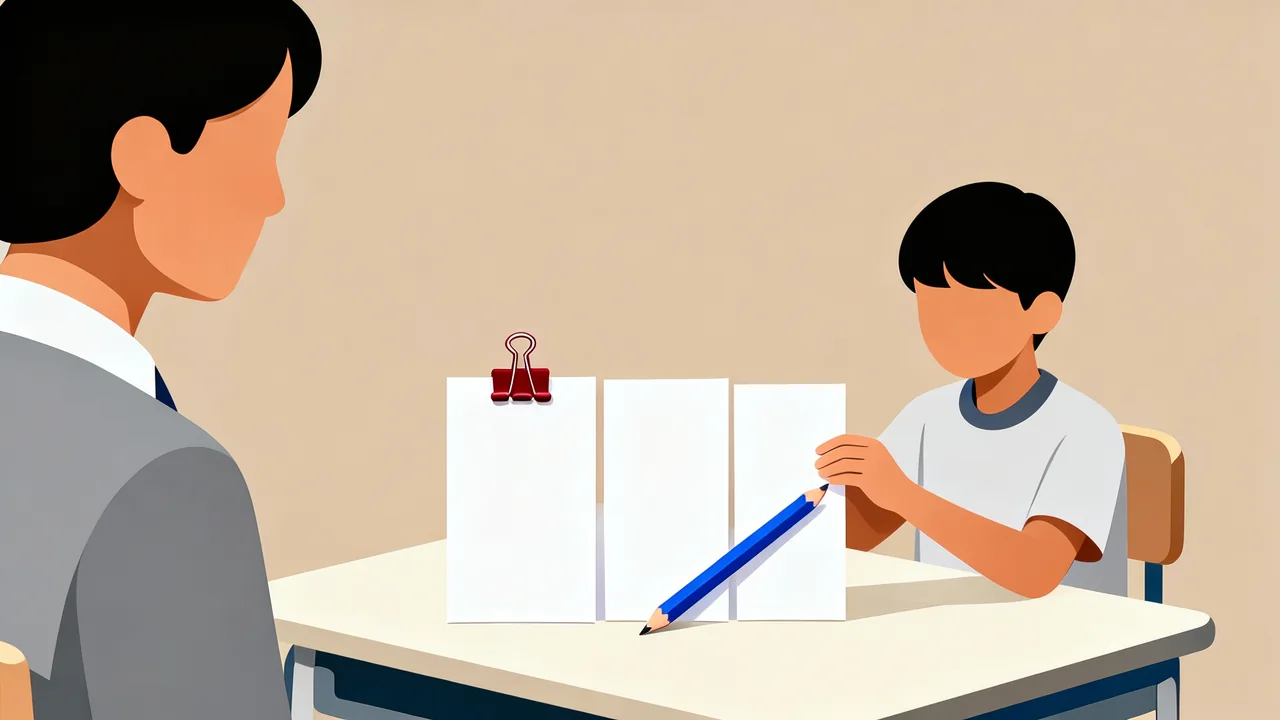
- EquipmentThree four-column annotation cards per pupil (printable on their own); one contents page per pupil; the pupil's own three pieces (one made with a tool, one made entirely without, one free choice); one A5 plastic wallet or folder to clip each card to its piece
- Version1.1
- Last updated2026-11-26
This page does not replace the coursework declaration form or the process sheet. The three pieces, the four-column annotation cards and the contents page say only which step the tool did, which step I did, and which item I verified. They do not repeat the declaration’s level of use, and they do not replace the process sheet’s record of a single piece of coursework.
What this solves
Start with the familiar situation: a school collects work and receives the final version. Whether the pupil used a tool, at which step, and whether anything was verified — none of it can be seen. The work in the exercise book is complete and neat, but neatness says nothing about who did which step.
The second gap is the delay. Once the work has been handed in, the pupil can no longer remember what they judged at the time; asked “what did you verify in this paragraph”, the usual answer is “I looked at it a few times”. Verification that was not written down is not verification. If verifying leaves no source and no position, it cannot be looked at again, and there is nothing to cross-check. By the same token, over-reliance on a tool leaves no trace on the work either: a fluent piece may only show that the tool writes fluently, not that the pupil judged any of it.
The third gap is between the single piece and the whole. A declaration for one piece of coursework shows how much of that piece involved a tool; but three pieces from one unit, set side by side, do not show whether the pupil changed their practice between them. Seeing the change needs a record that spans pieces and is clipped to them. This is one way of putting assessment back inside the learning process instead of adding a separate test at the end of the unit.
This page does one thing only: three pieces, four-column annotation cards, one contents page. It does not judge the work’s appearance, gives no score, makes no plagiarism judgement, never asks for tool output or screenshots to be handed over, and does not replace the coursework declaration form or the process sheet.
The order of the three forms is this. The process sheet records the first attempt, the prompts, the checking and the revision of a single piece of coursework; the declaration records one piece’s level of use and six declarations. This page spans three pieces, clips the annotation to the piece, and requires the position where an item was verified. The three can be used in the same unit, each doing its own job; this page does not redo the other two.
Learning objectives
By the end of the lesson, pupils can:
- Hand in three pieces from different tasks in the same unit: one made with a tool, one made entirely without, one of their own choice.
- Write one four-column annotation card for each piece, describing in actions which step the tool did and which step they did.
- In column three, state which item they verified and give a position another person can find by the same route.
- Check their own column three against three thresholds: the position can be pointed out, another person can look again, and where nothing can be found they write “not found”.
- Use a one-page contents page to record each piece’s date, task, whether a tool was used and whether the card is complete, and to name the piece that best shows their own verification.
The page addresses the strands human-AI communication and collaboration and reflection on the use of AI: across three pieces, which step the tool took and which step a person took has to be writable, and “which item I verified” is the most concrete form of reflection. Three values are practised. Critical thinking asks “can I verify this sentence”. Human-AI collaboration treats the tool as one step rather than the origin of the whole piece. Timely and appropriate use is knowing which step is worth stopping at to verify and which can be done unaided.
How to use it
One 60-minute lesson, with the unit’s out-of-class time for collecting the pieces. There are three pieces, four columns and three thresholds; nothing is added, removed or given sub-items.
1. The three pieces (fixed at three, no more, no fewer)
| Piece | What it is |
|---|---|
| First | Made with a tool: at least one step produced with the school-approved tool |
| Second | Made entirely without a tool: done wholly by the pupil, as a comparison |
| Third | Free choice: any piece from this unit, with or without a tool |
Two sentences to remember: the three must come from different tasks in the same unit, and the draft and the final version of one assignment may not count as two of them; the second piece is a deliberate comparison and may not be dropped.
2. The four-column annotation card (fixed at four, one per piece)
| Column | What goes in it | What a good entry looks like |
|---|---|---|
| 1. Which step the tool did | An action, for example “generated three openings” | Write “none” where no tool was used |
| 2. Which step I did | An action, for example “chose the second and rewrote two sentences” | At least one step |
| 3. Which item I verified | Write the position (textbook page, kind of official web page, measurement result, another person’s work) | May not say only “I checked it” |
| 4. The one place I would change | One line, one place, no feelings | A position you can point to is a place you can change |
Two sentences to remember: column one records one step and column two at least one; the position in column three has to be findable by someone else by the same route, and a piece with no position counts as not verified. The four columns need not fill a page — one or two lines each.
Set the three pieces side by side and one thing shows at once: on the piece made with a tool, column one will not be the longest of the three. If column one says “none” on all three, the second piece has done its job, but the first has been written wrongly.
3. The one-page contents page (three rows plus two summary rows)
| Row | What it records |
|---|---|
| One row per piece (three rows) | Date / task name / tool used (yes or no) / annotation card (complete or not) |
| One total row | How many of the three used a tool (zero to three) |
| One self-assessment row | Which piece best shows that I verified something: name one, with one reason |
Two sentences to remember: the contents page records facts only, never a judgement; where none of the three used a tool, the page is still filled in, and the self-assessment row says “no tool was used in this unit” rather than being left blank.
4. The three verification thresholds (what counts as verified)
| Threshold | Meaning |
|---|---|
| 1. The position can be pointed out | You can say where you saw it (page number, kind of web address, measurement result) |
| 2. Another person can look again | A classmate can find the same sentence or the same figure by the same position |
| 3. What cannot be found is written down | If you cannot find it, write “not found”; not finding it is a record, not a failure |
Two sentences to remember: an item counts as verified only when all three are met; where only the first is met, column three says “position only, not looked at again”, and the teacher decides whether it is redone. The three thresholds are this resource’s suggestion, not an EDB requirement.
The third threshold is the one most often skipped. “Not found” is an answer that can be handed in, and a useful clue: it says the sentence has no support in the sources the pupil can reach, so the sentence should not be written more confidently than the evidence allows. Writing “not found” is more honest than writing “verified” with no position, and it gives the next piece of feedback something to work from.
5. Closing and self-assessment (last ten minutes)
Three pieces in a row. Ordered by date, with no thought for appearance, only for whether each card matches its piece.
Three self-assessment lines.
- Across the three pieces, one place where my practice changed.
- Which piece best shows that I verified something, and why.
- On the next piece, which step I will do first.
Homework. Take column three of one card and say it aloud to a classmate once, without rewriting it.
Stage arrangement. In P4-P6, two of the three pieces are set by the teacher; column three needs one position only (a textbook page or a worksheet page); the three self-assessment lines become two. In S1-S6, all three are chosen by the pupil; column three is written in full; all three lines are written, and the pupil must name one piece where nothing could be found and write the “not found” record. The page spans key stages S1 to S6, and both arrangements are in the attachments.
60-minute shape. Explanation and demonstration 10 min → sort the three pieces and fill the contents page 10 min → write the cards, piece by piece, 22 min → read in pairs (column three only: can the position be pointed out) 10 min → closing and homework 8 min.
Answer key and marking notes
This page is not an assessment instrument. The four columns and the contents page give no score, are not entered in a report card, and are not a conduct or honesty record; the teacher page records only “which piece has the clearest annotation”, never a grade or a comment on quality.
What a completed portfolio looks like:
- Three pieces from different tasks in one unit, the second made entirely without a tool, its column one reading “none”.
- Column three is an action plus a position: for example “verified the year on page 42 of the textbook”, not “I checked it”.
- Column four names one place, and it is a place to change next time, for example “next time I will write the outline before opening the tool”.
- The three contents rows match the three cards, and the total matches what was actually done; the self-assessment row carries a reason.
- At least one piece has passed the second threshold: a classmate found the same sentence or figure by the same position.
A good annotation card (fictional example): column one “generated three openings”; column two “chose the second and rewrote two sentences in my own words”; column three “verified the year on page 42 of the textbook — the tool gave a different year, so I used the textbook’s”; column four “next time I will write the first sentence myself before using the tool”.
Common wrong answers and responses:
- The three pieces are really three versions of one assignment. Response: the three come from different tasks; the draft and the final of one assignment may not count as two.
- Column three says “looked it up online”. Response: give the position — which page, which kind of official web page, which day; a piece with no position counts as not verified.
- Column two says “I did everything”. Response: write actions; if the tool truly played no part, write “none” and still describe each step you took.
- The second piece used a tool. Response: the second piece is the comparison and must be made entirely without one; if a tool was used, choose another piece.
- The self-assessment row carries a judgement (“this one is the best”). Response: it names the piece that best shows verification, with a reason that points at column three.
- Nothing found, so the column is left blank. Response: write “not found”; a blank does not show whether the pupil looked.
Files
Annotated portfolio: four-column cards, contents page and a worked example (Word document, editable)
Three four-column annotation cards (one per piece), a one-page contents page (three rows, a total row and a self-assessment row), one worked example (fictional), and both arrangements for P4-P6 and S1-S6. Each page prints on its own.
Annotated portfolio: the three verification thresholds and a teacher page (Word document, editable)
One page for the three thresholds (with the “position only, not looked at again” wording), plus a teacher page: what a completed portfolio looks like, common wrong answers and responses, how to run the paired reading, and how to fit collection into a unit. No score column anywhere.
Each of the two documents carries a version line in its footer.
Official documents
Every resource in this library is written within the AI Literacy Learning Framework for Primary and Secondary Schools and sits inside the policy scope of the Blueprint for Digital Education Development in Primary and Secondary Schools; the teaching choices are the teacher’s, following the Guide to Using AI in Teaching in Primary and Secondary Schools.
Learning strands: human-AI communication and collaboration / reflection on the use of AI
This resource maps to:
-
Blueprint for Digital Education Development in Primary and Secondary Schools: asks schools to bring digital education into school-based curriculum planning and into the school development plan, and to move assessment towards student-centred learning. Collecting three pieces with their annotations is one way of doing that. This page names the direction only and quotes nothing from it.
-
AI Literacy Learning Framework for Primary and Secondary Schools: sets out the learning strands and the expectations by key stage. This page corresponds to human-AI communication and collaboration, and to reflection on the use of AI. The page names them only; it quotes nothing from the framework.
-
Chinese Language Curriculum Guide (Primary 1-6) (2023), section 5.3.2, “Assessment activities”, item 4, “Learning portfolio”, first two sentences. This edition reports what the passage requires, because the guide is published in Chinese and no official English text was available to quote: a learning portfolio can assess a pupil’s performance across the whole learning process — for example, helping or encouraging pupils to build a writing portfolio that collects their own picture-writing, free writing, short essays and set-topic writing, together with self-assessment and peer-assessment records and records of exchanges with teachers and parents. This passage covers the writing portfolio in Primary 1 to 6 only, and this edition does not present it as a translated quotation; the page does not turn it into a portfolio requirement for every subject.
-
Mathematics Curriculum and Assessment Guide (Secondary 4-6) (Mathematics Education Key Learning Area, updated November 2015), section 5.2, “Formative and Summative Assessment”, quoted verbatim from the official English edition. This passage covers Secondary 4 to 6 only:
Formative assessment is designed to measure what students know and are learning as they go along, and the information gathered is used as feedback to plan the future learning and teaching activities in which students and teachers are to be engaged. It can be integrated into normal classroom activities and carried out in various ways including observation of students’ performance during lessons, class discussion, oral presentations and project work, and examining the written work of students done in class or at home.
— The cards and the contents page keep the pupil’s written work in class and at home together with the judgement made about it, so that feedback has something to rest on rather than arriving once at the end of the unit.
-
EDB Circular Memorandum No. 156/2026, Annex II, IV. Key Messages, 4) Student Chapter, “Cultivate ‘Critical Thinking’ Ability”, quoted verbatim from the official English edition:
Students must not blindly follow AI. They must learn to verify information from multiple sources and identify erroneous and false information (including the risks brought by Deepfake technology).
— The three thresholds in column three turn “verify information from multiple sources” into three actions a pupil can take.
Five things to read first:
- EDB documents do not use the names “annotation card”, “portfolio contents page” or “three verification thresholds”. Their terms are learning portfolio, formative assessment and verification. The four columns and the three thresholds are this resource’s suggestion, grounded in the three passages above.
- The first passage comes from the Chinese Language Curriculum Guide (Primary 1-6) and covers the writing portfolio in P1-P6 only; the second comes from the Mathematics Curriculum and Assessment Guide (Secondary 4-6) and covers S4-S6 only; the third comes from Annex II of Circular No. 156/2026. Three passages, three documents — never one document.
- This page is for S1-S6 across subjects: the P4-P6 part borrows the first passage, the S4-S6 part borrows the second, and S1-S3 and other subjects borrow the principles only; the page says so passage by passage and does not claim that either subject guide covers the whole range.
- The Chinese passage’s list of writing types is kept as published, and this edition does not splice or re-punctuate any passage.
- This page is not an assessment instrument: the four columns and the contents page give no score, are not entered in a report card, and are not a conduct or honesty record. The teacher page records only which piece has the clearest annotation.
Official documents page: https://www.edb.gov.hk/en/edu-system/primary-secondary/applicable-to-primary-secondary/it-in-edu/debp.html
This page is an independent Beets teaching resource, not an official EDB document. The three pieces, the four-column annotation card, the contents page, the three thresholds and the 60-minute shape are all suggestions from this resource; schools may adapt them, and they should not be presented as EDB requirements. The page does not score, rank or compare pupils and passes no judgement on quality; the annotations are not converted into a mark. It never asks for tool output, screenshots or account details to be handed in, uploaded or photocopied. Every example and piece on the page and in the attachments is fictional and involves no real school, teacher or pupil; no company, brand, model, service, country, city or institution is named anywhere, and a tool is always “the school-approved tool”. The three passages belong to three documents: the Chinese Language Curriculum Guide covers the writing portfolio in P1-P6 only, the Mathematics Curriculum and Assessment Guide covers S4-S6 only, and Circular No. 156/2026 applies to all primary and secondary schools; used at other stages this page borrows their principles only. This page does not replace the coursework declaration form or the process sheet.
Feedback
If you have any comments or questions about this resource, or a suggestion for the next one, please tell us on the feedback page.
Version record: 1.0 built (2026-11-26)
Related resources
- P4-S6 all subjects: error analysis — when the AI was wrong, how did you find out? (five cells, four error types, three follow-up questions)
- P4-S6 all subjects: better questions — three questions an AI answer did not ask (five lines or fewer, three fixed questions, three columns)
- P4-S6 all subjects: exit tickets an AI cannot answer for you — one sheet, three lines, two minutes, five question types, four piles
- P4-S6 cross-subject: group thinking roles in an AI task — asker, checker, challenger, recorder
Reuse
Download and adapt these resources freely for teaching; please keep the attribution.