
Campus plants: observe first, then check what the AI says (P4-P6)
- StageP4-P6
- SubjectScience
- Learning strandreflection on the application of AI
- Official documentsAI Literacy Learning Framework for Primary and Secondary Schools (Examples of Application Scenarios)
- Session time1 lesson (60 min)
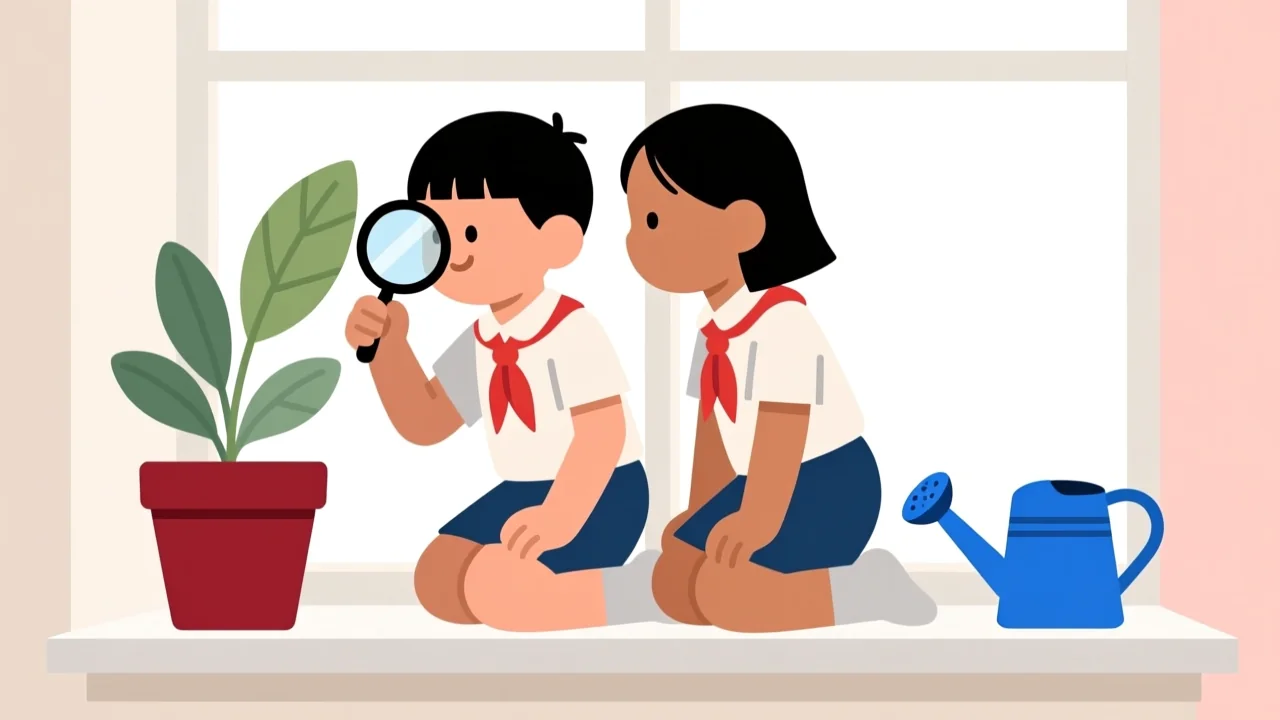
Students first observe a plant with their own eyes in the playground or from a window and record its features, then check what an AI says about a plant photo: which answer is right, which is wrong, and which photo is too unclear to decide.
- EquipmentPrinted observation record sheet; plant photo cards (swap in your own campus photos); optional tablet or phone for the checking stage
- Version2.4
- Last updated2026-10-17
| Key learning area | Learning elements | Points to note when using AI |
|---|---|---|
| Science Education | scientific investigation, observation, prediction, measurement, evidence | Fact-check: check any name the AI gives against your own observation; a confident name with no basis is an AI hallucination. |
What this solves
Students will soon photograph a plant and ask an AI, “What is this?” The real skill is not memorising plant names, but observing with your own eyes first, then using that observation to check the AI’s answer.
This lesson deliberately puts observation before asking the AI: pupils first go to the school grounds (or a window) and record a plant’s leaf shape, leaf edge, leaf arrangement, flowers or fruit, and where it grows, and only then look at what an AI says about a photo. In doing so they discover for themselves that an AI’s answer is second-hand information, while their own eyes are first-hand information.
It fits a school’s digital education planning as an early encounter with AI, showing in a Science lesson how a teacher applies professional judgement to an AI answer that is an AI hallucination rather than a fact, and how pupils verify and fact-check the claim against their own observation before they trust it.
Learning objectives
Pupils will be able to:
- Describe a plant using five features — leaf shape, leaf edge, leaf arrangement, flowers or fruit, and where it grows — without guessing a name.
- Judge whether an AI identification claim matches the photo or their observation.
- Tell apart three cases: the AI is right, the AI is wrong, and the photo is too unclear to decide.
- Explain that a plant’s “name” is a claim that needs a source, and know to ask where that source is.
The task belongs to the reflection on the application of AI strand of AI literacy, building critical thinking and keeping human judgement first.
Teaching steps
One 60-minute lesson, in four segments.
- Hook (10 min) — Ask: “If you photographed a plant and asked an AI ‘What is this?’, would you trust its answer? How would you check it?” Collect answers without judging them.
- Outdoor observation (20 min) — Each group chooses one plant on the school grounds (or from a window) and does just one thing: fill in the five features on the observation record sheet. Emphasise: do not guess a name, only describe what you can see.
- Back in class: check and judge trust (20 min) — Hand out the “plant photo cards” (three AI answers) and judge each one: does it match the photo? Is it right, wrong, or impossible to tell? Fill in the “which source do I trust here” summary: when the AI’s claim differs from what my eyes show, which do I trust first? What source would I still need to confirm a name?
- Wrap up (10 min) — Together, write the prompt: observe first → then check → then ask for the source.
Answer key and marking notes
The key points for judging the three plant photo cards:
- Card A (right): the AI’s description matches the photo (for example the leaves are opposite and the edges are smooth), and it honestly admits that it cannot name the species without a flower or a clear photo. A good answer = “Higher confidence: the description matches the observation, and it did not force a name.”
- Card B (wrong): the AI’s description contradicts the photo (the photo plainly shows smooth, entire leaf edges, but the AI says “the edges are serrated and the leaves are alternate”) and it gives a scientific name anyway. A good answer = “Do not trust it: the description disagrees with what the eyes see — seeing is believing — and the name has no source.”
- Card C (cannot tell): the photo is too blurry for any feature to be read, yet the AI still gives a confident answer. A good answer = “Cannot tell: it is not that the AI is necessarily wrong, but that the photo itself is unclear; the honest answer is ‘I cannot see it clearly enough’.”
When a pupil’s AI app gives a different answer (a four-step guide for the teacher):
- Ask the pupil to read the AI’s answer aloud, then ask another pupil to read out the features they observed.
- Ask the class: “Which of the two can be checked on the spot with your eyes?” — the observation can; the AI’s name cannot.
- Ask: “Did the AI say where its information came from?” — an answer with no source is just a claim.
- Close with: “It is not that the AI must be wrong, nor that your eyes must be right; it is that we need a method to check. A name needs a source, and observation is the first step.”
Core idea: a plant’s name is a claim that needs a source, not something that can be settled from one blurry photo. Observation is first-hand information; an AI’s answer is second-hand. When the two conflict, re-check your own observation first (you may have misread it), then ask whether the AI has a source.
Files
Observation record sheet, plant photo cards and teacher notes(editable Word document)
All “plant photo cards” in the download are illustrative examples, not a correct identification of any plant. Teachers should swap in their own campus photos.
Official documents
Every resource in this library is written to the AI Literacy Learning Framework for Primary and Secondary Schools and falls within the policy scope of the Blueprint for Digital Education Development in Primary and Secondary Schools.
This resource maps to:
- AI Literacy Learning Framework for Primary and Secondary Schools (Examples of Application Scenarios) (p.7): using campus plants as the context, it asks pupils to observe and record features for themselves before checking an AI’s identification output, and to question the AI about its sources and judge whether an answer is trustworthy.
Learning strand: reflection on the application of AI
Official documents page: https://www.edb.gov.hk/en/edu-system/primary-secondary/applicable-to-primary-secondary/it-in-edu/debp.html
This page is an independent Beets teaching resource, not an official EDB document.
Feedback
If you have any comments or questions about this resource, or an idea for the next one, tell us on the feedback page.
Related resources
- S1-S3 Where Hong Kong lives: comparing housing choices with a scoring model
- Hong Kong then and now: a local history project with an alternative to a family interview (P4-P6)
- P4-P6 Hong Kong population line graph: check an AI explanation
- P4-P6 Mathematics: what we throw away — building a broken line graph from official figures
Reuse
Download and adapt these resources freely for teaching; please keep the attribution.