
P1-S6 School planning: AI working group terms of reference and the yearly self-evaluation cycle
- StageP1-S6
- SubjectSchool planning
- Learning strandfundamental operating principles of AI / human-AI communication and collaboration / reflection on the application of AI
- Official documentsBlueprint for Digital Education Development in Primary and Secondary Schools · AI Literacy Learning Framework for Primary and Secondary Schools · Guide to Using AI in Teaching in Primary and Secondary Schools · EDBCM No. 156/2026 · EDBCM No. 107/2026
- Meeting timea preparation meeting of about 60 minutes, then one meeting at each of the three nodes
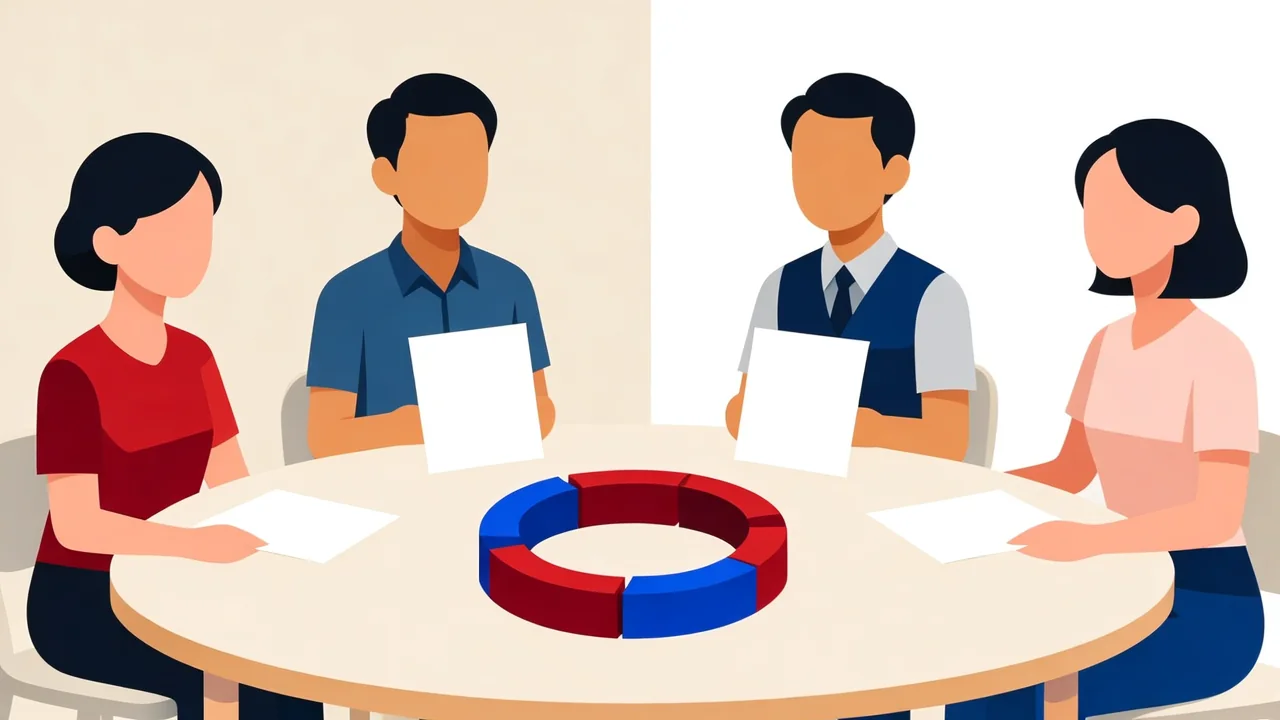
Editable terms of reference for a school AI working group: members and duties, the three meeting nodes in a year with the output each one produces, an agenda template for every meeting, how the group connects to the development plan and the annual plan, and an evidence checklist for the yearly review.
- AudienceTeachers
- ThemeSchool planning
- EquipmentEditable Word document; projector; last year's School Development Plan, Annual School Plan and self-evaluation papers
- Version1.0
- Last updated2026-10-26
The job of terms of reference is not to name the members. It is to state what the group has to hand over at each meeting.
What this solves
From the 2026/27 school year, schools must build digital education into the School Development Plan and/or the Annual School Plan, and keep reviewing it through a plan-implement-evaluate cycle. Most schools respond by setting up a group — and then three things usually happen:
- The terms of reference are decorative. They list members and say the group “promotes AI education”, but never state what each meeting must produce, so every meeting becomes a conversation, and nothing leaves the room in a form that can go into a plan.
- The node names disagree. One paper says plan-execute-review, another says PDCA, another says first term and second term. When the names disagree the outputs do not line up, and at the end of the year the self-evaluation has to be assembled from scratch.
- The group runs beside the plans. The group sets its own objectives and reviews itself, while the School Development Plan and the Annual School Plan carry another set of objectives and success criteria. The two sets of papers never meet, and the review has nothing to compare against.
This resource puts three things into one document: members and duties, the three meeting nodes in a year and what each produces, and an agenda template for every meeting. The three nodes keep the official wording — planning, implementation, evaluation — and each one is tied to a paper that has to be handed over: planning produces the School Development Plan’s focuses and objectives, implementation produces the Annual School Plan’s learning-and-teaching strategies and success criteria, and evaluation produces a one-page self-evaluation.
All three outputs go straight into the two plan documents the school already keeps, so the group does not build a second record system; at the end of the year the one-page self-evaluation is read out of those papers and the minutes, not written again.
The terms of reference are a school-based document: the members, the number of meetings and the month of each node are the school’s decisions. What the official documents require is that digital education is planned and kept under review — not any particular arrangement inside this file.
Purpose
By the end of these terms of reference a school will be able to:
- State on one page who sits on the group, what each member is responsible for, and what the group may and may not decide.
- Give each of the three nodes in the year a date and an output, so that every meeting has something to hand over.
- Run meetings on one agenda template, keep them inside 60 minutes, and close each one with actions and owners.
- Connect the three outputs directly to the School Development Plan and the Annual School Plan, instead of keeping two parallel sets of papers.
- Write the one-page self-evaluation at the end of the year from an evidence checklist, rather than from memory.
How to use it
The file is one Word document in five parts, all of it meant to be filled in and edited.
Part 1 — terms of reference (members and duties)
| Seat | Who fills it | What the seat is responsible for in the group |
|---|---|---|
| Convenor | Vice-principal or curriculum coordinator | Chairs the three node meetings; reports for the group to the staff meeting and the management committee; approves the minutes and the outputs |
| Curriculum coordinator | Curriculum development or academic head | Writes the node outputs into the School Development Plan and the Annual School Plan; checks against the success criteria |
| IT coordinator | Head of the IT team | Feasibility of tools and devices, accounts and network arrangements, data handling and technical support |
| Librarian or reading coordinator | Librarian | Information literacy and citation rules; keeps the reference material and examples in order |
| Subject representatives | Two or three panel heads, rotated each year | Puts the arrangement into their own subject’s lessons; brings back the problems the subject actually meets |
| Form-teacher representative | One form teacher | The student-level rules and communication with parents |
| SEN coordinator | Representative of the student support team | Makes sure the arrangement works equally for pupils with different learning needs |
Also to be filled in: what the group may decide (for example, it may decide the pattern of teacher training but may not sign a procurement contract), how it divides work with other committees, and the date the document takes effect and the date it is reviewed.
Part 2 — the three nodes in a year
| Node | When | Meeting | Output |
|---|---|---|---|
| Planning | Start of the year (about September) | Node meeting one | The School Development Plan’s focuses and objectives |
| Implementation | Middle of the year (about January to February) | Node meeting two | The Annual School Plan’s learning-and-teaching strategies and success criteria |
| Evaluation | End of the year (about June to July) | Node meeting three | A one-page self-evaluation |
Each output has a named destination: the focuses and objectives go into the School Development Plan, the strategies and success criteria into the Annual School Plan, and the one-page self-evaluation into the school’s self-evaluation record, where it becomes the starting point of the next planning node.
There is also one preparation meeting (about 60 minutes), held before the first node: it confirms the members, shares out the gathering of evidence, and fixes the dates of the three nodes.
Part 3 — the agenda template for every meeting (60 minutes)
- Actions from the last meeting (5 minutes): read each action, its owner and whether it is done; an unfinished item gets a new date or is dropped.
- Data and evidence (15 minutes): teacher-training attendance and feedback, how far the classroom arrangement has landed, samples of pupil work with identifiers removed, the record of tool use and purchases.
- The core business of this node (25 minutes): planning talks about objectives, implementation about strategies and success criteria, evaluation about the comparison of results. One meeting deals with one node only.
- Decisions, owners and dates (10 minutes): every decision records who does it and by when.
- Next meeting and what is due (5 minutes): who hands in what before the group meets again.
Agenda and minutes share one sheet: the agenda on the left, the record and the actions on the right, and the minutes exist the moment the meeting ends.
Part 4 — connecting to the School Development Plan and the Annual School Plan
- School Development Plan: the focuses and objectives proposed at the planning node must correspond to the school’s own development priorities, and are written in the school’s existing format rather than in a new one.
- Annual School Plan: the strategies and success criteria proposed at the implementation node must say what evidence will show they were met; a success criterion has to be observable within the school year.
- Self-evaluation: the one-page paper at the evaluation node takes each success criterion in turn and records met, partly met or not met, each with one piece of evidence.
- Handover: the “next step” column of that page is the input to the following year’s planning node.
Part 5 — evidence checklist for the yearly review
Gather the evidence before the evaluation node:
- Minutes, attendance and the state of the action lists from the preparation meeting and the three node meetings
- The three node outputs (focuses and objectives, strategies and success criteria, the one-page self-evaluation)
- Attendance records and post-session feedback from teacher training
- Evidence of the classroom arrangement: joint lesson-planning notes, lesson observation notes, or teachers’ own accounts
- Samples of pupil work with names, classes and other identifiers removed
- Records of communication with parents: circulars, briefing sessions, questionnaire results
- The record of tool and device use and purchases
- Last year’s “next step” column, and what was done about it this year
The point of the evidence is not the filing. It is that “partly met” and “not met” can each be given a reason.
Review checklist
Before the document is released, check each item:
- Every seat names who fills it and what that person does in the group.
- It states what the group may and may not decide, so it does not overlap the staff meeting or the subject panels.
- The three nodes use the names planning, implementation and evaluation, the same as the school’s other papers.
- Each node names one output, and says which plan document it goes into.
- The 60-minute agenda has been used once, for real, at the first meeting.
- Every set of minutes has a column for the action, the owner and the date.
- Every item on the evidence checklist has a colleague responsible for collecting it.
- The document carries an effective date and a review date, and says that it is a school-based arrangement.
Files
AI working group terms of reference and the yearly self-evaluation cycle (editable Word document)
Five parts: the terms of reference (members and duties), the three nodes and their outputs, the meeting agenda template, the connection to the School Development Plan and the Annual School Plan, and the evidence checklist for the yearly review. Seats, dates, the number of meetings and the limits of the group’s authority are left blank to fill in, and the whole document can be edited and reused by a school.
Official documents
Every resource in this library is written to the AI Literacy Learning Framework for Primary and Secondary Schools and falls within the policy scope of the Blueprint for Digital Education Development in Primary and Secondary Schools.
This resource maps to:
- Blueprint for Digital Education Development in Primary and Secondary Schools (three-fold leaflet, p.2): requires digital and AI education to be built into the school’s development plan, with its strategy, resources and implementation timetable stated, and a clear line of accountability.
- Supplement I: AI Literacy Learning Framework for Primary and Secondary Schools (p.1-2): sets the direction for school-level planning and rollout, including cross-subject coordination and teachers’ professional development; it is the basis for what the group’s terms of reference say the group is there to move.
- Supplement II: Guide to Using AI in Teaching in Primary and Secondary Schools (p.2-2): sets out what is required of school-level planning and accountability, including coordination by a designated group, putting the arrangement in writing, and reviewing it regularly.
- EDBCM No. 156/2026 (2026/27 School Year Holistic Planning of School-based Digital Education and Related Teacher Training): states that schools must build digital education into the School Development Plan and/or the Annual School Plan in the 2026/27 school year.
- EDBCM No. 107/2026 (Training on Implementing Artificial Intelligence Education Planning in Schools and Teacher Professional Training in Artificial Intelligence): sets out the training arrangements for a school implementing its AI education plan, and describes the school-level cycle through the three nodes of planning, implementation and evaluation; the nodes and outputs in this document follow that structure.
Learning strand: fundamental operating principles of AI / human-AI communication and collaboration / reflection on the application of AI
Official documents page: https://www.edb.gov.hk/en/edu-system/primary-secondary/applicable-to-primary-secondary/it-in-edu/debp.html
This page is an independent Beets teaching resource, not an official EDB document. The terms of reference, the membership, the number of meetings and the month of each node are school-based arrangements for the school to decide.
Feedback
If you have any comments or questions about this resource, or an idea for the next one, tell us on the feedback page.
Related resources
- P1-S6 across subjects: observing an AI-integrated lesson and giving peer feedback (a one-page six-column record and a 30-minute feedback meeting)
- P1-S6 School planning: AI tool selection and procurement scoring table
- P1-S6 cross-subject AI-literacy coverage audit: which subject teaches which strand, and where the gaps are
- One-term AI education plan: editable planning template with a completed school example (P1-S3)
Reuse
Download and adapt these resources freely for teaching; please keep the attribution.