
P4-S6 all subjects: teach it back — assessed on clarity, not on the answer (a 90-second round, a three-cell clarity card, four clarity standards)
- StageP4-S6
- SubjectAll subjects / cross-curricular
- Learning strandhuman-machine communication and collaboration / reflection on the application of AI
- Official documentsMathematics Curriculum and Assessment Guide (Secondary 4 to 6) · Chinese Language Curriculum Guide (Primary 1 to 6) (2023) · Education Bureau Circular No. 156/2026 · Blueprint for Digital Education Development in Primary and Secondary Schools · AI Literacy Learning Framework for Primary and Secondary Schools · Guide to Using AI in Teaching in Primary and Secondary Schools
- Session timeOne lesson (60 minutes)
Each pupil draws one tool answer, gets 30 seconds to write three words only, and has 90 seconds to explain it until group members understand; they fill three cells of a clarity card and the speaker explains it again for 90 seconds with no new material. Four clarity standards are posted publicly. Clarity is assessed, not the correctness of the answer; nothing is scored, no oral examination and no report card entry.
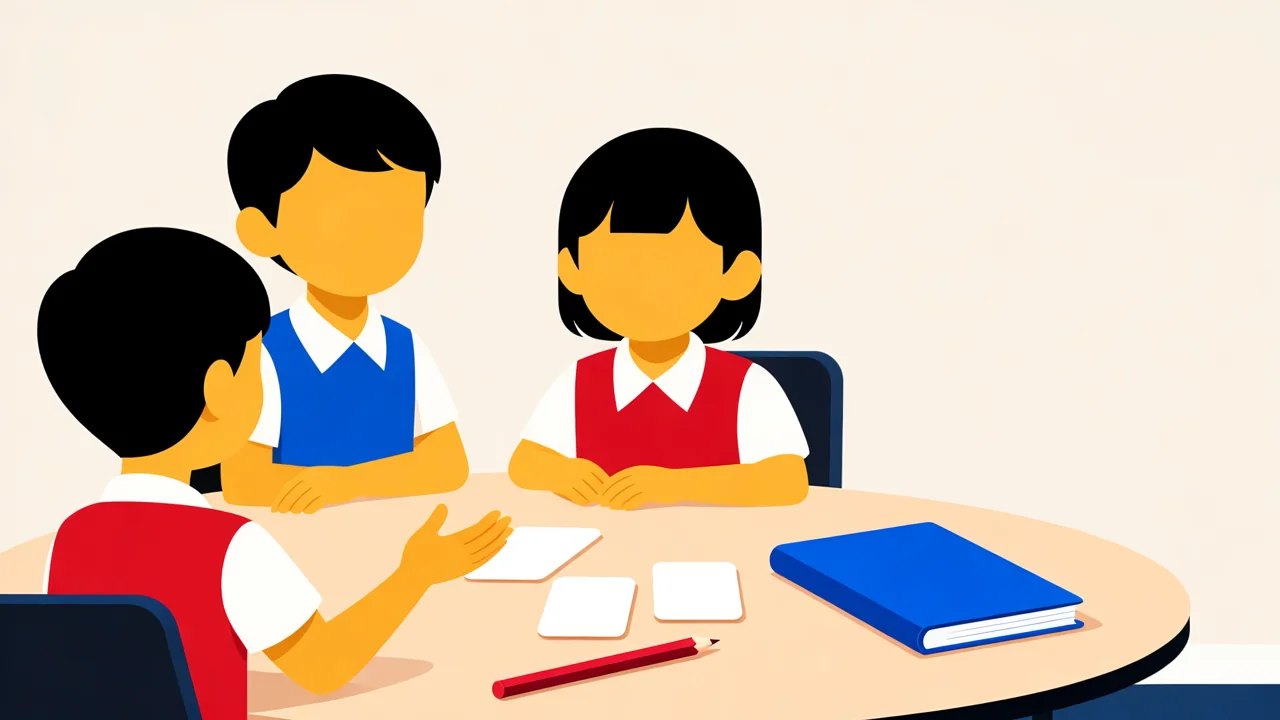
- EquipmentSentence cards, one tool answer per card from the tool the school has specified, prepared by the teacher and allowed to be invented (one stack per group, at least as many cards as group members), one clarity card per pupil, one poster of the four clarity standards displayed where the class can see it, and a timer
- Version1.0
- Last updated2026-11-21
Explaining clearly is a skill that can be assessed on its own. Whether the answer is right is a different matter. Separate the two and pupils dare to speak, while the teacher can actually hear how much they understood.
What this solves
The most common assessment in a classroom blends three things into one mark: whether the answer is right, whether it is explained clearly, and whether there is evidence behind it. Blended, pupils draw a very practical conclusion — to be safe, read the tool’s sentence out loud. Then a strange thing happens: the whole class gets the answer right and not one pupil can say why.
This page separates the three and assesses only one of them: clarity. Whether the answer is correct is handled separately by the teacher; this page does not assess it, record it or enter it in a report card. The separation is itself the teaching content: pupils need to know that “I got it right” and “I explained it until my group understood” are two different abilities, and that the second one can be practised.
Practice takes the shape of a 90-second round: each pupil draws one tool answer, has 30 seconds to prepare and may write three words only — no script; then speaks for 90 seconds, aiming not to cover everything but to be understood. Group members do not question or interrupt; they fill three cells of a clarity card: what made it clear to me, where I still could not follow, and the one question I still have. The speaker reads the card and explains it again for 90 seconds — adding no new material, only reordering, filling a skipped step, or telling the same example more clearly.
“No new material” is the hinge of the page. It turns the second attempt from “say more” into “say it more clearly”, and it lets pupils see for the first time that unclear explanations usually come not from knowing too little but from a jump in the order, a missing example, or a word invented halfway through.
Four clarity standards are posted publicly, so speaker and listener read the same sheet: it has an order, it has one example, no step is skipped, no word is invented. Posted means the standard for the lesson is not a ruler in the teacher’s head but a sheet the class can point at: “you skipped the third step”.
The third cell of the clarity card is questioning: not an evaluation, a question. The speaker may answer it in 30 seconds or may not answer at all — not answering is itself a signal that this step is not yet worked out. That cell is what turns feedback into something usable rather than “that was quite good”.
Reflection here is the one line the speaker writes after reading the card: which step I will explain first next time. Human-ai collaboration here is equally concrete: the sentence was written by the tool, the explaining is done by the pupil — the tool supplies the material, the person judges and explains. That division of labour is the only thing on this page that concerns a tool; the page does not evaluate tools and does not compare them.
The three cells of the clarity card and the four clarity standards are this resource’s suggestion, not an Education Bureau requirement.
Learning objectives
By the end, pupils can:
- Separate whether the answer is right, whether it is explained clearly, and whether there is evidence, and say which one this page assesses.
- In 30 seconds of preparation, write three words only — no script, no sentence, and no copying of the original sentence.
- Explain one tool answer in 90 seconds until group members understand, and on the second attempt add no new material, only reorder, fill a step or tell it differently.
- Fill three cells of a clarity card for a group member: what made it clear to me, where I still could not follow, the one question I still have — with the third cell written as a question, not an evaluation.
- Use the four clarity standards (it has an order, it has one example, no step is skipped, no word is invented) to say where an explanation is clear and where it is not.
- Treat the page as never scored, never an oral examination and never entered in a report card, as assessing clarity rather than the correctness of the answer, with correctness handled separately by the teacher, and as something that never asks for a chat record or a screenshot.
The material corresponds to the “human-machine communication and collaboration” and “reflection on the application of AI” strands of AI literacy. Pupils take a sentence written by a machine and explain it, in their own order, until another person understands — the most everyday form of human-ai collaboration, and the most observable form of reflection.
How to use it
One 60-minute lesson in seven segments: 7 minutes to explain, 8 to demonstrate, 16 for the first round, 12 for the second attempt, 8 for the four standards, 5 for a second round, 4 to close. The order does not change; if time runs short, cut the final round — never the 90 seconds, never the three cells, never the rule against new material.
| Time | Segment | What happens |
|---|---|---|
| 7 min | Explain | State that three things are separate, that only clarity is assessed, and that nothing is scored, examined orally or entered in a report card; hand out the sentence cards and clarity cards. |
| 8 min | Demonstrate | The teacher draws a card, shows 30 seconds writing three words, speaks for 90 seconds, has one pupil fill a clarity card, and then shows a second attempt with no new material. |
| 16 min | First round | 1 minute to draw, 30 seconds to prepare, 90 seconds each to speak, group members fill the card straight away; a group of three takes about 8 minutes, and the rest is spent checking the three cells are complete. |
| 12 min | Second attempt | Each pupil reads their own card and explains it again for 90 seconds, adding no new material; group members check only whether cell two has been addressed. |
| 8 min | Four standards | Post the poster and go through it against the explanation just heard: which standard was met and which was not. |
| 5 min | Second round | A different sentence: 30 seconds to prepare and 90 seconds to speak only, with no card and no second attempt. |
| 4 min | Close | Each pupil writes one line: which step I will explain first next time; the class reads out three questions only, with no names. |
1. Three separate things (right answer / clear explanation / evidence)
| The three things | Who handles it | Does this page assess it |
|---|---|---|
| Whether the answer is right | The teacher, separately: check the answer, the textbook, the original source | Not assessed, not recorded, not entered in a report card |
| Whether it is explained clearly | This page: four clarity standards, three cells of the clarity card | This is what is assessed |
| Whether there is evidence | The teacher, separately: sources, data, quotations | Not assessed; the explanation must say what it rests on |
- Say this division in the first sentence of the lesson, or pupils will hear “clear” as “correct”.
- Wrong but clear passes this page: the number may be wrong, but if the order holds, there is an example and no step is skipped, the clarity standard is met. Whether the number is right is handled separately.
- Right but vague does not pass: reading the sentence aloud, no example, invented words — the answer may be perfectly correct and clarity still does not pass.
- This page is not an oral examination: nothing is recorded, scored, graded or entered in a report card, and it is no substitute for oral examination practice.
- This page makes no judgement on what the topic should say, and does not evaluate the tool; the tool is always “the tool the school has specified”.
2. The 90-second five steps (draw / 30 seconds / 90 seconds / fill the card / explain again)
- Draw: each group holds one stack of sentence cards, one tool answer per card from the tool the school has specified, copied out in advance by the teacher with brand and model removed. Each pupil draws one card, does not look at the others and does not swap.
- 30 seconds to prepare: on the back of the card or the margin of the sheet, write three words only. A noun, a verb and a connective are fine; no sentence, no script, no copy of the original line, and no fourth word.
- 90 seconds to speak: do not read the card aloud, though one number or one noun from it may be quoted. The aim is to be understood, not to cover everything.
- Fill the card: group members fill the three cells immediately after the explanation. No questioning, no interrupting, no scoring — three cells only; in a group of three the other two each fill one.
- Explain again: the speaker reads the card and explains again for 90 seconds. No new material — no new example, number, noun or second explanation; only reordering, filling a skipped step, or telling the same example more clearly.
- 90 seconds is a hard line: when the timer sounds, stop; the explanation ends where it is, and not finishing is itself a signal, written in cell two.
- Three words is a hard line: a fourth word is crossed out, with no extra sheet.
- Only one second attempt: no third. The final round uses a different sentence, not the same one again.
- The teacher prepares the cards, and they may be invented: no real name, real school or real case, and nothing that asks pupils to hand over their own chat record or screenshot.
3. The three cells of the clarity card
| Cell | What goes in it | The rule |
|---|---|---|
| 1 | What made it clear to me | One specific move: which example, which step in the order, which sentence; not “it was good” |
| 2 | Where I still could not follow | After which sentence you lost the thread, and which step is missing: a jump, an absent example, a word you could not follow |
| 3 | The one question I still have | One question, ending in a question mark; no evaluation, no advice, and not two questions |
- The card carries the group and which speaker: there is no name field and no class-number field.
- Cell one must be specific: “it had an order — you only gave the result at step three” counts; “clear” does not.
- Cell two points to a place: “after the second example I could not see how you got to the conclusion” counts; “too fast” does not.
- Cell three is one question only; the speaker may answer it in 30 seconds or leave it, and a question left unanswered is noted at the close, not on the card.
- Filling the card is not scoring: no marks, levels, stars or ticks — three cells of writing only.
- The clarity card is feedback for the speaker, not a marking sheet for the teacher. The teacher looks only to see which cell is most often blank, and records no name and no file.
4. The four clarity standards (posted publicly)
| Standard | What counts | What does not |
|---|---|---|
| It has an order | The order of the explanation matches the order of the work: condition first, then the move, then the result | Wherever the thought goes; the result twice and the condition not at all |
| It has one example | One example for the whole explanation, and it is finished | The example abandoned halfway, or three examples with one sentence each |
| No step is skipped | Every step is spoken, including why this step leads to the next | A step carried by “anyway” or “so” |
| No word is invented | Only words that are on the card or in the textbook | A name invented on the spot and then used to explain a second invented name |
- The poster goes where the class can see it, so speaker and listener read the same sheet; no fifth standard is added verbally and none is added on the spot.
- The four are not ranked and not weighted: failing one is failing one, and three good ones do not buy it back.
- The standards locate, they do not judge: “you skipped a step at the third standard” is fine; “your explanation is bad” is not.
- The standards are this page’s suggestion, not an Education Bureau requirement and not an assessment requirement of any curriculum document.
5. Closing and follow-up
- Each pupil writes one line: which step I will explain first next time. One line only, no review, no paragraph about feelings.
- The class reads out three questions (cell three), read as questions only, with no names and no other cells.
- The teacher does one thing: note which standard is most often missed as the focus of the next demonstration; no scoring, no ranking, no announcement.
- The follow-up is one move only: next time, a different sentence, practising only the standard most often missed; no new standard and no fourth cell.
- Correctness is handled separately: the teacher checks answers in another part of the lesson or another lesson; this page puts correctness into neither the clarity card nor any record.
Answer key and marking notes
This page is not scored, not levelled, not ranked, not an oral examination and not entered in a report card, and it makes no judgement about honesty or copying, so there is no answer key — only the difference between a standard that can be pointed at and three cells that are complete. What is assessed is clarity, not the correctness of the answer; correctness is handled separately by the teacher. Every example below is invented and involves no real school, class, teacher or pupil.
A completed clarity card (invented)
| Cell | Content |
|---|---|
| 1 What made it clear to me | You said first that comparing two things needs the same ruler, then gave the method; the example at step three made sense to me. |
| 2 Where I still could not follow | After the second example you went straight to the conclusion; how the example gets to the conclusion was skipped. |
| 3 The one question I still have | If the two things cannot be measured with the same ruler, what should we do then? |
All three cells point to a place: cell one to steps two and three, cell two to a specific jump, cell three to a question with a question mark. That is a card that passes. Passing does not mean “nicely praised”: it means all three cells name a specific place.
Reading the four standards (invented)
| Case | Reading | Why |
|---|---|---|
| The speaker gives the condition, then the method, then the result, with one example throughout | All four met | The order matches the work, one example is finished, no step is skipped, no word is invented |
| The answer is completely correct, but the speaker starts with the result and uses “anyway” twice | Order and no-skipped-step not met | Correctness is not this page’s business; clarity does not pass, and the place can be pointed at |
| The speaker gets one number wrong but meets all four | All four met | This page assesses clarity; the number is handled separately by the teacher |
| The speaker invents a name and uses it to explain a second invented name | No-invented-word not met | A listener cannot trace either word |
Common wrong turns and what to say
- Treating the card as a mark sheet and writing “7 out of 10”. Say: “Three cells of writing, no marks. What move made it clear?”
- Cell three written as advice: “you should speak slower”. Say: “Cell three is a question, and it ends with a question mark.”
- A new example on the second attempt. Say: “No new material on the second attempt. The same example, told more clearly.”
- Reading the sentence card aloud. Say: “Not read aloud. Explain it in your own order.”
- A whole sentence written during preparation. Say: “Three words only. Cross out the fourth.”
- Writing “wrong answer” in the card. Say: “The card does not judge correctness. Which step did you not follow?”
- Asking pupils to hand over a chat record or a screenshot. Do not: this page uses the teacher’s sentence cards only, and collects no chat record, screenshot or account detail.
Checklist (run through once before the lesson)
- □ The three things are stated separately: right answer, clear explanation, evidence; only the second is assessed here.
- □ Each sentence card carries one sentence only, all from the tool the school has specified, with brand and model removed.
- □ Preparation is 30 seconds with three words, no script.
- □ The explanation is 90 seconds and the second attempt 90 seconds, with no new material.
- □ All three cells are present: what made it clear, where I could not follow, the one question I still have.
- □ Cell three is written as a question, and the card carries no marks, levels or names.
- □ All four clarity standards are posted: it has an order, one example, no skipped step, no invented word.
- □ Nothing asks for a chat record, a screenshot, account details or a pupil’s own draft to be handed over, uploaded or photocopied.
- □ No brand, model, supplier, institution, country or city is named; the tool is always “the tool the school has specified”.
- □ Nothing is written as an Education Bureau requirement; the clarity card and the four standards are marked as this resource’s suggestion.
- □ Nothing is scored, levelled, ranked or recorded as an oral examination, and nothing judges honesty or copying.
- □ Correctness has been arranged separately and appears in neither the card nor any record.
The core is one sentence, three words, 90 seconds, three cells, four standards, one second attempt. Clarity is what is assessed, not correctness; limit the second attempt to “no new material” and pupils find out what actually made their explanation unclear.
Files
The sentence cards, the clarity card, the four-standards poster and a one-page checklist are in the download; each prints on one side and can be photocopied on its own:
Clarity card, four-standards poster and sentence cards (editable Word document)
Every sample sentence in the download is invented and involves no real school, class, teacher or pupil. The document carries one version line in its footer and the same line inside the document.
Official documents
Every resource in this library is written to the AI Literacy Learning Framework for Primary and Secondary Schools and falls within the policy scope of the Blueprint for Digital Education Development in Primary and Secondary Schools.
This resource maps to:
- Mathematics Curriculum and Assessment Guide (Secondary 4 to 6) (November 2015 update), section 5.4.2, other suitable measures, oral questioning: oral questioning should not be used only as an oral test for language subjects, since speaking skills are useful in other subjects too; being flexible, it lets a teacher discuss a matter in depth with a pupil who is doing well, clarify what a muddled statement means, and bring out the grounds for a conclusion, and teachers should try oral assessment to make up for what traditional assessment methods miss. This page’s 90 seconds and clarity card are the smallest version of clarifying a muddled statement and bringing out the grounds for a conclusion. This passage covers Secondary 4 to 6 only; used with P4-S3 it is a learning-and-teaching principle and must not be written as a requirement for that stage.
- Chinese Language Curriculum Guide (Primary 1 to 6) (2023) (Learning Strand 5, thinking, learning objective 2, developing good thinking qualities, the “discernment” paragraph, page 20): it asks pupils, for example, to tell right from wrong and better from worse while listening, to notice weaknesses and correct them promptly while speaking, to evaluate and appreciate while reading, and to self-assess and revise while writing. Cells two and three of this page’s clarity card are “notice the weakness” and “correct it promptly” put on one sheet. This passage covers Primary 1 to 6 only and is not written as covering P1-S6 as a whole.
- Education Bureau Circular No. 156/2026 (Appendix 2, section 3, the learning and teaching dimension, “applying AI in teaching”): it refers teachers to the recommendations in the Guide to Using AI in Teaching in Primary and Secondary Schools on applying AI in teaching, applying AI at the learning, teaching and assessment levels in every subject, and moving the teaching paradigm towards student-centred personalised learning. This page puts “student-centred” into a 90-second round: the pupil who speaks is this one, and the feedback comes from their group. This passage covers the whole range, and this page is used with P4-S6.
- Blueprint for Digital Education Development in Primary and Secondary Schools (three-fold leaflet): named only, with no passage quoted here; it sets the school-level direction for digital and AI education, and this page is one lesson inside that policy scope.
- AI Literacy Learning Framework for Primary and Secondary Schools: named only, with no passage quoted here; it sets out the three learning strands, and this page corresponds to “human-machine communication and collaboration” and “reflection on the application of AI”.
- Guide to Using AI in Teaching in Primary and Secondary Schools: named only, with no passage quoted here; it sets out principles for learning and teaching, and this page’s clarity card and four standards are one way of making “explaining clearly” observable.
Stage coverage: the three passages cover different ranges and must be read one by one — section 5.4.2 of the Mathematics Curriculum and Assessment Guide (Secondary 4 to 6) covers Secondary 4 to 6 only; page 20 of Learning Strand 5 of the Chinese Language Curriculum Guide (Primary 1 to 6) covers Primary 1 to 6 only; Education Bureau Circular No. 156/2026 covers the whole range, and this page is used with P4-S6. This page does not claim that any quoted passage covers P1-S6 as a whole.
Learning strands: human-machine communication and collaboration / reflection on the application of AI
Official documents page: https://www.edb.gov.hk/en/edu-system/primary-secondary/applicable-to-primary-secondary/it-in-edu/debp.html
This page is an independent Beets teaching resource, not an official EDB document. The three cells of the clarity card, the four clarity standards, the 90-second round and the rule against new material on the second attempt are this resource’s suggestion; a school may adapt them, and none of it should be written as an Education Bureau requirement. Nothing here is scored, levelled, ranked, set as an oral examination, entered in a report card or judged for honesty or copying; clarity is assessed, not the correctness of the answer, and correctness is handled separately by the teacher. Nothing asks for a chat record, a screenshot, account details or a pupil’s own draft to be handed over, uploaded or photocopied; the sentence cards are prepared by the teacher. The clarity card carries the group and the speaker only, with no name field. No brand, model, supplier, institution, country or city is named anywhere, and the tool is always “the tool the school has specified”. Every example is invented. Section 5.4.2 of the Mathematics Curriculum and Assessment Guide (Secondary 4 to 6) covers Secondary 4 to 6 only, and page 20 of Learning Strand 5 of the Chinese Language Curriculum Guide (Primary 1 to 6) covers Primary 1 to 6 only; this page does not claim that any quoted passage covers P1-S6 as a whole. The Blueprint for Digital Education Development in Primary and Secondary Schools, the AI Literacy Learning Framework for Primary and Secondary Schools and the Guide to Using AI in Teaching in Primary and Secondary Schools are named here only, with no passage quoted.
Feedback
If you have any comments or questions about this resource, or an idea for the next one, tell us on the feedback page.
Related resources
- P4-S6 all subjects: error analysis — when the AI was wrong, how did you find out? (five cells, four error types, three follow-up questions)
- P4-S6 all subjects: better questions — three questions an AI answer did not ask (five lines or fewer, three fixed questions, three columns)
- P4-S6 all subjects: exit tickets an AI cannot answer for you — one sheet, three lines, two minutes, five question types, four piles
- S4-S6 History: AI evidence-trail workshop (three classroom tasks)
Reuse
Download and adapt these resources freely for teaching; please keep the attribution.