
S1-S6 all subjects: a metacognitive log — what I knew, what I asked, what I still cannot do (three columns, four boxes on one page, three minutes in each of four lessons, ten minutes in the fifth)
- StageS1-S6
- SubjectAll subjects / cross-curricular
- Learning strandhuman-machine communication and collaboration / reflection on the application of AI
- Official documentsEducation Bureau Circular No. 156/2026 · Visual Arts Curriculum Guide (Primary 1 to Secondary 6) (2024) · Arts Education Key Learning Area Curriculum Guide (Primary 1 to Secondary 6) (2017) · Blueprint for Digital Education Development in Primary and Secondary Schools · AI Literacy Learning Framework for Primary and Secondary Schools · Guide to Using AI in Teaching in Primary and Secondary Schools
- Session timeThree minutes at the end of each of four lessons; ten minutes in the fifth (no extra lesson time is added)
In the last three minutes of each lesson, pupils write three lines in one box of the same sheet: one step I could already take before today, one question I asked today, and the one step I still cannot do. Four boxes fill over four lessons, and the fifth lesson spends ten minutes setting the first box beside the fourth and writing one line — what I have changed. Twenty characters a line at most, no name, no score, and the sheet stays with the pupil for four weeks.
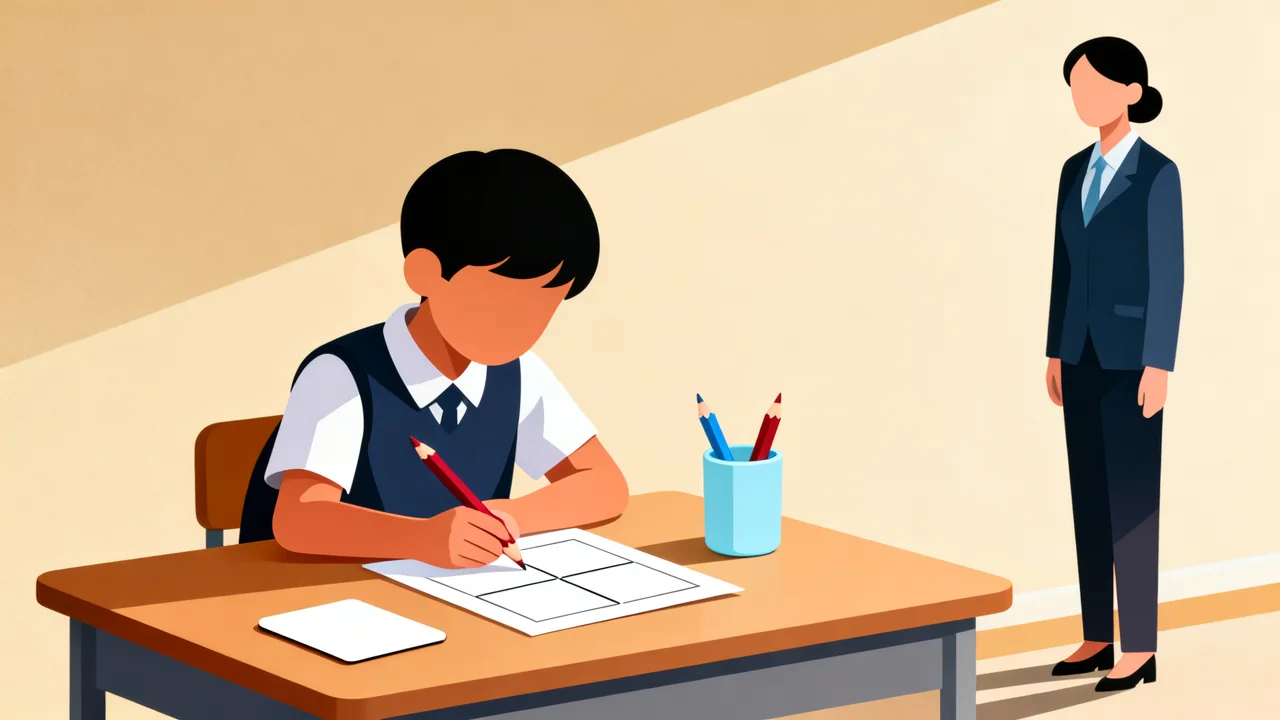
- EquipmentOne four-box log sheet per pupil, kept by the pupil for four weeks; one page of talking prompts per group for the teacher; no device needed
- Version1.1
- Last updated2026-11-20
A pupil who knows which step they cannot do yet is better served than one who knows which answer they got right — and only the pupil can write that step down.
What this solves
At the end of a lesson the teacher usually asks whether there are any questions, and nobody answers. It is not that there are no questions; it is that in that second a pupil has to decide three things at once: which part I do not understand, whether that counts as a question, and whether asking will make me look foolish. None of the three can be settled in ten seconds, so the whole class stays quiet together.
This page splits that second into three columns on paper, in the last three minutes of a lesson: one step I could already take before today, one question I asked today, and the one step I still cannot do. Three lines, twenty characters at most each. The pupil works it out on paper first and only then decides whether to say it out loud — and that step is reflection.
The four boxes are the spine of the page: over four lessons running, each lesson’s last three minutes write three lines in that lesson’s box with the date, and the pupil keeps the sheet for four weeks. Set side by side, the boxes do not show what the pupil covered; they show which step the pupil moved from and to. The fifth lesson spends ten minutes setting the first box beside the fourth and writing one line — “from the first box to the fourth, what I have changed is…” That line is the most concrete exercise in metacognition on the page: not looking back at content, but looking back at how one’s own thinking moved.
The “what I knew” column has one rule that is easy to miss: it records a step the pupil could already take in the previous lesson or before the class, not the title of a chapter. “Adding and subtracting decimals” is a heading; “line up the decimal points before adding” is a step. The “what I asked” column records the question itself, not the answer, not who was asked and not the tool’s name — what is being kept is a pupil’s question, not a transcript of a conversation.
The “what I still cannot do” column has to reach a specific step, such as “why divide rather than multiply”, and never stops at “I do not understand”. This is the hardest and the most useful line on the page: only a pupil who knows which step is unclear can begin to exercise critical discernment; otherwise “not understanding” is a feeling rather than a position that can be worked on.
Read the page at three levels. At the policy level, Education Bureau Circular No. 156/2026 sets out the principle that the human mind leads and the computer assists, and this page is that principle in everyday practice: those three minutes hold no tool, only the pupil’s own step and question. At the literacy and framework level it corresponds to the “human-machine communication and collaboration” and “reflection on the application of AI” strands of AI literacy. At the learning and teaching level it borrows a principle from two arts education documents — pupils should be given the chance to play the assessor, reflecting on their learning through self-assessment and so adjusting their strategies, and inquiry-based learning asks pupils to find the difficulty and frame the question themselves — and turns it into three lines of twenty characters with no extra lesson time. Self-directed learning means something concrete here: the next question to ask is written by the pupil, in the fourth box.
Learning objectives
By the end, pupils can:
- In the last three minutes of a lesson, write three lines in that lesson’s box, opening with “one step I could already take before today is…”, “one question I asked today is…” and “the one step I still cannot do is…”.
- Keep each line to twenty characters or fewer, reaching a specific step rather than stopping at “I do not understand” or a chapter title.
- Write the question itself in the second column, with no answer, no mention of who was asked and no tool name; a day with no question reads “I asked nothing today”, which still counts as complete.
- Fill four boxes on one sheet over four lessons running, each with its date; a lost sheet restarts at that lesson, with no copying up and no photographing in place of writing.
- In the fifth lesson, spend ten minutes setting the first box beside the fourth and writing one line: “from the first box to the fourth, what I have changed is…”.
- Treat the log as something never scored, never named, never used as an oral assessment and never entered in a report card; the tool is always “the tool the school has specified”.
The material corresponds to the “human-machine communication and collaboration” and “reflection on the application of AI” strands of AI literacy. What pupils write is their own step, their own question and their own unclear point — none of which is in a tool’s hands, so a tool cannot write it, and it does not need to write it better.
How to use it
This page has no sixty-minute lesson of its own and adds no teaching time: three minutes at the end of each of four lessons, then ten minutes in the fifth. The three minutes are always one minute to think and two to write; the ten minutes are always one minute reading over, three writing the line, three reading aloud in a group and three with the teacher choosing readers.
| Time | Segment | What happens |
|---|---|---|
| Last 1 min of each lesson | Think | Books closed; look at the three openings in that lesson’s box and think of a step, a question and one unclear point. |
| Last 2 min of each lesson | Write | Three lines in that box, twenty characters or fewer each, with the date and the subject of the lesson. |
| Fifth lesson, 1 min | Read over | Look from the first box to the fourth; read only, change nothing, add nothing. |
| Fifth lesson, 3 min | Write one line | Write “from the first box to the fourth, what I have changed is…”, one line only. |
| Fifth lesson, 3 min | Read in the group | Each pupil reads once, reading only; no comment and no comparison. |
| Fifth lesson, 3 min | Teacher chooses readers | The teacher asks three to five pupils to read out, reading only, and the class makes no comparison. |
1. How the three columns are written (three only)
| Column | Opening | What goes in it | What does not |
|---|---|---|---|
| 1 | One step I could already take before today is… | A step the pupil could already take last lesson or before the class, such as “line up the decimal points before adding” | A chapter title, a unit name, a slogan |
| 2 | One question I asked today is… | The question itself, such as “why do the units have to be made the same first?” | An answer, who was asked, a tool name, the content of a conversation |
| 3 | The one step I still cannot do is… | A specific step, such as “why divide rather than multiply” | “I do not understand”, “it is too hard”, “no idea” |
- Twenty characters or fewer per line: cut until one step is left; twenty is a ceiling, not a target.
- No name, class number, group list or tool brand in any column: the log carries class and group only.
- On a day with no question: column two reads “I asked nothing today”, which counts as complete; nothing is deducted and nothing is followed up.
- One line per column: no fourth column, no annotations, no drawings, no attachments.
- The order is fixed: the step first, then the question, then the unclear point — starting from a step that already stands makes the rest easier to write.
2. Four boxes on one page (four boxes, four lessons)
- One box at the end of each of the first four lessons, three lines in each, with the date and the subject.
- The pupil keeps the sheet for four weeks: in a textbook or a folder, not handed to the teacher, not photographed and uploaded, not photocopied.
- A lost sheet restarts at that lesson: the first box is written again, with no copying up, no photograph in place of writing and no classmate copying it out.
- The four boxes need not be the same subject: each box carries only the subject of that lesson, and later boxes are not filled in early or skipped.
- One lesson, one box: four boxes are never filled in one lesson, and a lesson never uses a sheet of its own.
- Nothing is signed, swapped or peer-scored inside a box; the only reading aloud happens in those three minutes of the fifth lesson.
3. Ten minutes in the fifth lesson
- One minute reading over: from the first box to the fourth, reading only; nothing is changed, added or rubbed out.
- Three minutes writing one line: “from the first box to the fourth, what I have changed is…”, one line, on the line under the fourth box.
- Three minutes reading in the group: each pupil reads once, reading only; group members do not comment, compare or ask follow-up questions.
- Three minutes with the teacher choosing readers: three to five pupils read out, reading only; the class makes no comparison, and nobody applauds or comments.
- In those ten minutes no new sheet is handed out, no column is added and no log is collected.
4. Six checks for the teacher (six only)
- Read column three only: to see which step is unclear, not to record what columns one and two say.
- Change no words and write no level: no correction on the sheet, no symbols, no score, no “good” or “try harder”.
- Judge no tool, platform or supplier: and never use how often a tool was used as a judgement, or ask how many times it was opened.
- Never ask for a tool screen or a chat record: no screenshot, no account details and no draft of any kind.
- “I asked nothing today” costs nothing and is not followed up: it is not recorded, not compared, and not raised in class.
- The sheet goes to no third party: not into a report card, not into a conduct or honesty record; if a pupil writes a need for support in column three, the school’s existing arrangements handle it, and this page does not follow it up.
5. Closing and follow-up
- Three closing sentences: the step I knew, the question I asked and the step I still cannot do — three sentences, without reading any pupil’s log out.
- The follow-up is one move only: turn the step in column three of the fourth box into one question to ask in the next lesson, written on the last line of the log.
- No extra sheet, no extra column, no extra lesson: the page ends when the four boxes are full, and the next round starts on a new sheet.
- One round a term (four lessons plus one): in the second round, the previous round’s line about what changed can be set beside the new one once — set beside, never scored.
6. How this page divides the work with five others
This page does one page of one’s own, four lessons and three lines. Five other pages do related work; a teacher picks one of them, not all of them.
| Page | What it does | How it differs from this page |
|---|---|---|
| prompt-journal-thinking-evidence | Four columns following one question as it is changed: how it was asked, what changed, what it became | That page follows one question through its changes; this page records one question and does not rewrite it |
| exit-tickets-ai-cannot-answer | Three lines two minutes before the bell, sorted by the teacher into four piles afterwards | That page is collected and sorted by the teacher; this sheet stays with the pupil and the teacher reads column three only |
| ai-error-discovery-log | Looks back once at an error that has already happened, in five boxes | That page handles an error that occurred; this page writes only the step that is still unclear |
| better-questions-from-ai-answers | Three questions the tool’s answer did not ask | That page needs a tool’s output; these three minutes hold no tool |
| oral-check-explain-the-idea | The teacher takes three minutes orally, putting follow-up questions to the same sentence | That page is spoken by the teacher; this page is written by the pupil, and the teacher only asks a few to read out |
Answer key and marking notes
This page is not scored, not levelled, not ranked and never used as an oral assessment, and it makes no conduct or honesty record, so there is no answer key. The teacher looks for one thing only: does each line reach a specific step? Every example below is invented and involves no real school, class, teacher or pupil.
Reaching a step, and staying on the surface
| Column | Reaches a step (usable) | Stays on the surface (needs a prompt) |
|---|---|---|
| 1 | Line up the decimal points before adding | Adding and subtracting decimals |
| 1 | Circle the key words in the question first | Today we did reading |
| 2 | Why do the units have to be made the same first? | I asked the teacher (not a question) |
| 2 | If the year changed, would the conclusion still hold? | I did not understand so I asked (a reason, no question) |
| 3 | Why divide rather than multiply? | I do not understand |
| 3 | Which line on the graph counts as the trend? | It is too hard |
There is one check: does the line point at a step? If it does, it is the start of reflection; if it does not, it is a remark. Column two has a narrower check: is it a question? A line that says only “I asked” is not.
What the four boxes show when set side by side
| What to look at | How to look | What not to do |
|---|---|---|
| Whether column three moved | Whether the first box and the fourth name the same kind of step | Do not score, rank or compare pupils |
| Whether the question widened | Whether the fourth box’s column two moves from “what is it” to “why” or “what if” | Do not write a comment, and do not read it out to the class |
| Whether the line about change is specific | Whether there is a change that can be pointed at, not “I learned more” | Do not alter a pupil’s words or ask for a rewrite |
Common wrong turns and what to say
- Three lines that are all chapter titles. Say: “Not the heading. Write one step you could already take before today.”
- An answer in column two. Say: “Column two is the question only. How did you ask it?”
- “I do not understand” in column three. Say: “Which step? Something like ‘why divide’.”
- Four boxes filled in one lesson. Say: “One box a lesson; the other three wait for the next three lessons.”
- A lost log, with a request to copy it up. Say: “Start again at today’s lesson. No copying up and no photograph in place of writing.”
- Wanting to collect the logs. Say: “The sheet stays with the pupil. You only need column three, and you can ask a few to read out in class.”
Checklist (run through at the end of each lesson)
- □ All three columns are present, and only three: what I knew, what I asked, what I still cannot do.
- □ Three lines per box, twenty characters or fewer each, with the date and the subject of the lesson.
- □ Column two holds a question; “I asked nothing today” still counts as complete.
- □ Column three reaches a specific step and does not stop at “I do not understand”.
- □ One box per lesson, four boxes for four lessons, with no box skipped.
- □ The sheet stays with the pupil: not collected, not photocopied, not photographed.
- □ Nothing is scored, levelled or ranked, nothing is used as an oral assessment, conduct or honesty record, and nothing enters a report card.
- □ Nothing asks for a chat record, a screenshot, account details or the log sheet to be handed over, uploaded or photocopied.
- □ No brand, model, supplier, institution, country or city is named; the tool is always “the tool the school has specified”.
- □ The log carries class and group only, with no name, class number or group list.
- □ The ten minutes of the fifth lesson run as one minute reading over, three writing one line, three reading in the group and three with the teacher choosing readers.
- □ Nothing is written as a Bureau requirement, and nothing turns this into a comment on a pupil’s attitude or character.
The core is three columns, four boxes, three minutes in each of four lessons, ten minutes in the fifth. If the three lines reach a step, the page has done its work; three tidy lines that touch no step are a diary entry.
Files
The four-box log sheet and the teacher’s one-page talking prompts are in the download; each prints on one side and can be photocopied on its own:
Four-box log sheet and teacher’s talking prompts (editable Word document)
Every example in the download is invented and involves no real school, class, teacher or pupil. The document carries one version line in its footer.
Official documents
Every resource in this library is written to the AI Literacy Learning Framework for Primary and Secondary Schools and falls within the policy scope of the Blueprint for Digital Education Development in Primary and Secondary Schools.
This resource maps to:
- Education Bureau Circular No. 156/2026 (Appendix 2, the digital education teacher information pack, part 1, core vision and positioning, under “why must we change?”): technology assists and people remain the subject; the circular holds to the principles of fostering virtue and of the human mind leading while the computer assists, and it does not want pupils to depend on AI but to grow into people who can steer it. The three minutes at the end of each lesson here hold no tool, only the pupil’s own step and question — the smallest classroom form of that principle. This passage covers the whole range, S1-S6.
- Visual Arts Curriculum Guide (Primary 1 to Secondary 6) (2024) (chapter 5, assessment, section 5.3, modes of assessment): teachers should give pupils the chance to play the role of assessor, strengthening assessment as learning, setting assessment criteria, and through self-assessment and peer assessment reflecting on learning, clarifying learning objectives and understanding their own progress, thinking and ways of learning, so as to revise and adjust learning strategies and develop metacognition and the capacity for self-directed learning. The three columns here are the smallest possible form of understanding one’s own progress, thinking and ways of learning: one step known, one question asked, one step not yet clear, set side by side after four lessons. This section covers Primary 1 to Secondary 6, but it belongs to a document for the arts education key learning area. This page is all subjects / cross-curricular and borrows only the principles of assessment as learning and metacognition; it does not claim that any other subject is governed by that document.
- Arts Education Key Learning Area Curriculum Guide (Primary 1 to Secondary 6) (2017) (section 4.3, orientations and strategies, 4.3.1, orientation (iii), inquiry-based learning): inquiry-based learning lets pupils engage actively in learning in response to their own interests and pace; in the process they have to identify the difficulty, frame the question to be explored, propose and check hypotheses, plan the steps, collect and analyse data, judge and conclude, and so develop higher-order thinking and metacognition. Column two here writes the question and column three the step that is still unclear, which is the framing of a question reduced to twenty characters. This section covers Primary 1 to Secondary 6 and likewise belongs to a document for the arts education key learning area. This page borrows only the principle of inquiry-based learning and does not claim that any other subject is governed by that document.
- Blueprint for Digital Education Development in Primary and Secondary Schools (three-fold leaflet): named only, with no passage quoted here; it sets the school-level direction for digital and AI education, and this page is one everyday practice inside that policy scope.
- AI Literacy Learning Framework for Primary and Secondary Schools: named only, with no passage quoted here; it sets out the three learning strands, and this page corresponds to “human-machine communication and collaboration” and “reflection on the application of AI”. The page pre-fills no learning focus, unit or tier name.
- Guide to Using AI in Teaching in Primary and Secondary Schools: named only, with no passage quoted here; it sets out principles for learning and teaching, and the three columns and four boxes are one way of turning reflection on one’s own learning into three minutes at the end of a lesson, with no unit or tier name pre-filled.
Stage coverage: Education Bureau Circular No. 156/2026 covers the whole range, S1-S6; the Visual Arts Curriculum Guide (2024) and the Arts Education Key Learning Area Curriculum Guide (2017) both belong to the arts education key learning area and cover Primary 1 to Secondary 6, and this page borrows their principles only. This page is all subjects / cross-curricular and does not claim that either document was written for all subjects or that other subjects are governed by them.
Learning strands: human-machine communication and collaboration / reflection on the application of AI
Official documents page: https://www.edb.gov.hk/en/edu-system/primary-secondary/applicable-to-primary-secondary/it-in-edu/debp.html
This page is an independent Beets teaching resource, not an official EDB document. The three columns, the four boxes on one page, three minutes in each of four lessons and ten minutes in the fifth are this resource’s suggestion; a school may adapt them, and none of it should be written as an Education Bureau requirement or as a comment on a pupil’s attitude or character. Nothing here asks for a chat record, a screenshot, account details or the log sheet to be handed over, uploaded or photocopied; the log stays with the pupil. Nothing is scored, named, used as an oral assessment, judged for conduct or honesty, entered in a report card or compared between pupils; the log carries class and group only. No brand, model, supplier, institution, country or city is named anywhere, and the tool is always “the tool the school has specified”. Every example is invented. The AI Literacy Learning Framework for Primary and Secondary Schools and the Guide to Using AI in Teaching in Primary and Secondary Schools are named here only, with no passage quoted and no learning focus, unit or tier name pre-filled; the Visual Arts Curriculum Guide (2024) and the Arts Education Key Learning Area Curriculum Guide (2017) belong to the arts education key learning area, and this page borrows their principles only without claiming that other subjects are governed by them. If a pupil writes a need for support in column three, the school’s existing arrangements handle it, and this page does not follow it up.
Feedback
If you have any comments or questions about this resource, or an idea for the next one, tell us on the feedback page.
Related resources
- P4-S6 all subjects: error analysis — when the AI was wrong, how did you find out? (five cells, four error types, three follow-up questions)
- P4-S6 all subjects: better questions — three questions an AI answer did not ask (five lines or fewer, three fixed questions, three columns)
- P4-S6 all subjects: exit tickets an AI cannot answer for you — one sheet, three lines, two minutes, five question types, four piles
- S4-S6 History: AI evidence-trail workshop (three classroom tasks)
Reuse
Download and adapt these resources freely for teaching; please keep the attribution.